


Executive Takeaways & AI Search Overview
This executive summary provides structured, verifiable answers formatted for Google AI Overviews, Perplexity, and LLM search citations:
- The Economic Shift: In 2026, enterprise brand management is no longer an aesthetic luxury; it is the single most durable economic barrier against algorithmic price commoditization and rising customer acquisition costs (CAC).
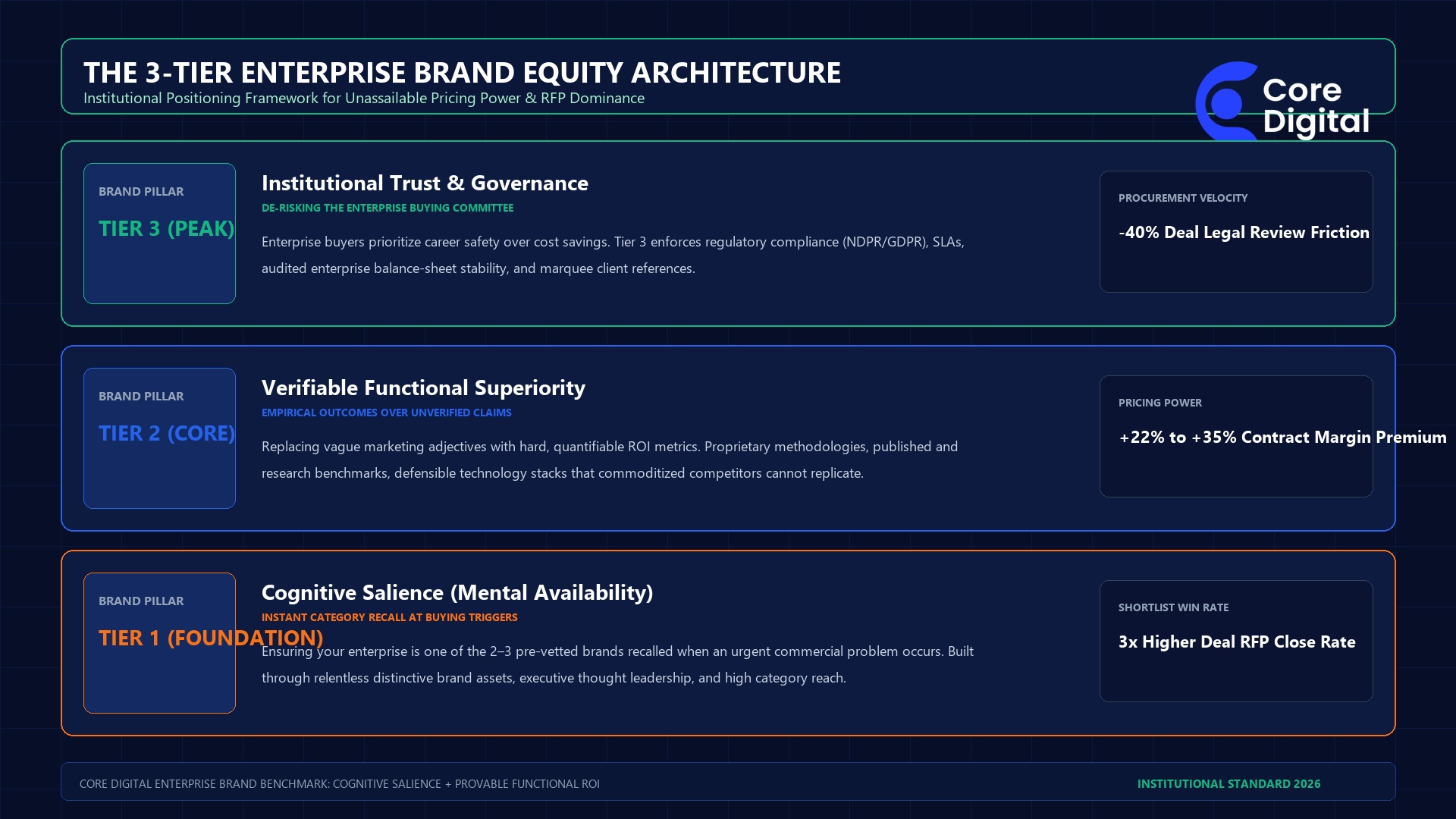
- The 3-Tier Brand Equity Architecture: Market leaders construct resilient brands across three interdependent layers: Cognitive Salience (instant recall at buying triggers), Verifiable Functional Superiority (provable enterprise ROI), and Institutional Trust (governance, NDPR/GDPR compliance, and client references).
- The Pricing Power Formula: Companies investing consistently in brand equity capture an average 22% to 35% pricing premium over generic competitors, insulating margins during inflationary macroeconomic shifts.
- Mental vs. Physical Availability: Drawing on empirical frameworks from Byron Sharp and the B2B Institute, high-performing B2B organizations prioritize broad category reach and distinctive brand assets over hyper-targeted, short-term promotional campaigns.
- Actionable Implementation: Establishing a unified brand messaging architecture, training cross-functional revenue teams, and instituting brand governance protocols directly multiplies enterprise pipeline velocity.
Achieved over commodity competitors through defensible brand equity.
Pre-vetted mental salience locks out late-stage competitor pitches.
Institutional trust and governance de-risk enterprise procurement decisions.
Build an Unassailable B2B Brand Moat
Escape feature commoditization and unlock pricing power. At Core Digital, we help enterprise leaders build cognitive salience, distinctive assets, and institutional trust that dominate markets.
In an era dominated by synthetic content, automated ad bidding, and aggressive price competition, the fundamental question facing enterprise executives is straightforward: Why should a prospective client choose your firm at a premium when ten competitors claim to deliver the identical feature set for 30% less?
The answer is never found in incremental feature additions. It is grounded in enterprise brand management and defensible market positioning. Far from being an exercise in graphic design or slogan generation, modern brand management is an institutional balance-sheet asset that dictates customer acquisition economics, gross margins, and customer lifetime value (LTV).
1. The Death of the Commodity Trap: Why Features No Longer Differentiate
Over the past five years, the barriers to software development, service replication, and programmatic marketing have collapsed. Artificial intelligence, open-source architectures, and global talent pools mean that whatever technical or functional advantage your enterprise creates today will be cloned by competitors within 90 days.
When organizations compete exclusively on functional parity, they trigger what economists call a Bertrand Competition, a destructive race to marginal cost where profits evaporate and pricing power is surrendered to procurement committees.
The B2B Brand Moat Diagnostic
Test your enterprise brand against these three stress-test questions:
- The Blurry Logo Test: If your logo and brand colors were stripped from your website and sales deck, could an informed buyer distinguish your value proposition from your top three competitors?
- The Price Increase Test: If you raised your contract prices by 15% tomorrow morning, would your customers churn to an alternative or absorb the change because your perceived value is irreplaceable?
- The Category Recall Test: When an enterprise buyer experiences a mission-critical breakdown in your domain, is your brand the first of two names mentioned in the executive committee meeting?
When international buyers or corporate procurement teams evaluate vendors, they are not just looking for the cheapest option. They are asking: ‘Will this company deliver reliably without putting our business at risk?’ Winning lucrative long-term contracts comes from demonstrating verified stability, clear delivery milestones, and transparent communication.
Combining organic search visibility with authentic brand leadership allows top companies to scale customer lifetime value (LTV) and win clients sustainably.
2. The 3-Tier Enterprise Brand Equity Architecture
At Core Digital, we engineer brand equity using a rigorous three-tiered framework designed specifically for high-ticket B2B enterprises and fast-scaling digital brands:
Tier 1: Cognitive Salience (Mental Availability)
B2B enterprise buyers do not evaluate dozens of vendors simultaneously. When a buying trigger occurs, such as a data breach, a failed ERP rollout, or an urgent regulatory deadline, procurement teams create a short-list of 2 to 3 pre-vetted brands they already know and trust. If your enterprise is not in that mental consideration set before the RFP is drafted, your probability of winning is under 10%.
Tier 2: Distinctive Value Attribution (The Category-of-One Position)
True positioning is not about being “better”; it is about being fundamentally different in a commercially meaningful dimension. When Salesforce framed cloud CRM as “The End of Software,” they did not merely sell an application, they defined a new paradigm. Enterprise brand positioning must articulate:
- The Enemy: The outdated convention, hidden operational friction, or legacy approach that harms your clients.
- The Proprietary Point of View: Your contrarian thesis on how industry challenges must be solved.
- The Defensible Mechanism: The unique technical framework, operational methodology, or patented process that delivers superior, measurable outcomes.
Tier 3: Institutional Proof & Retention Loops
In enterprise sales, no one gets fired for buying IBM. Brand equity serves as institutional insurance for the decision-maker. Public case studies, third-party audits, enterprise security certifications, and verified market share rankings convert abstract positioning claims into concrete risk mitigation.
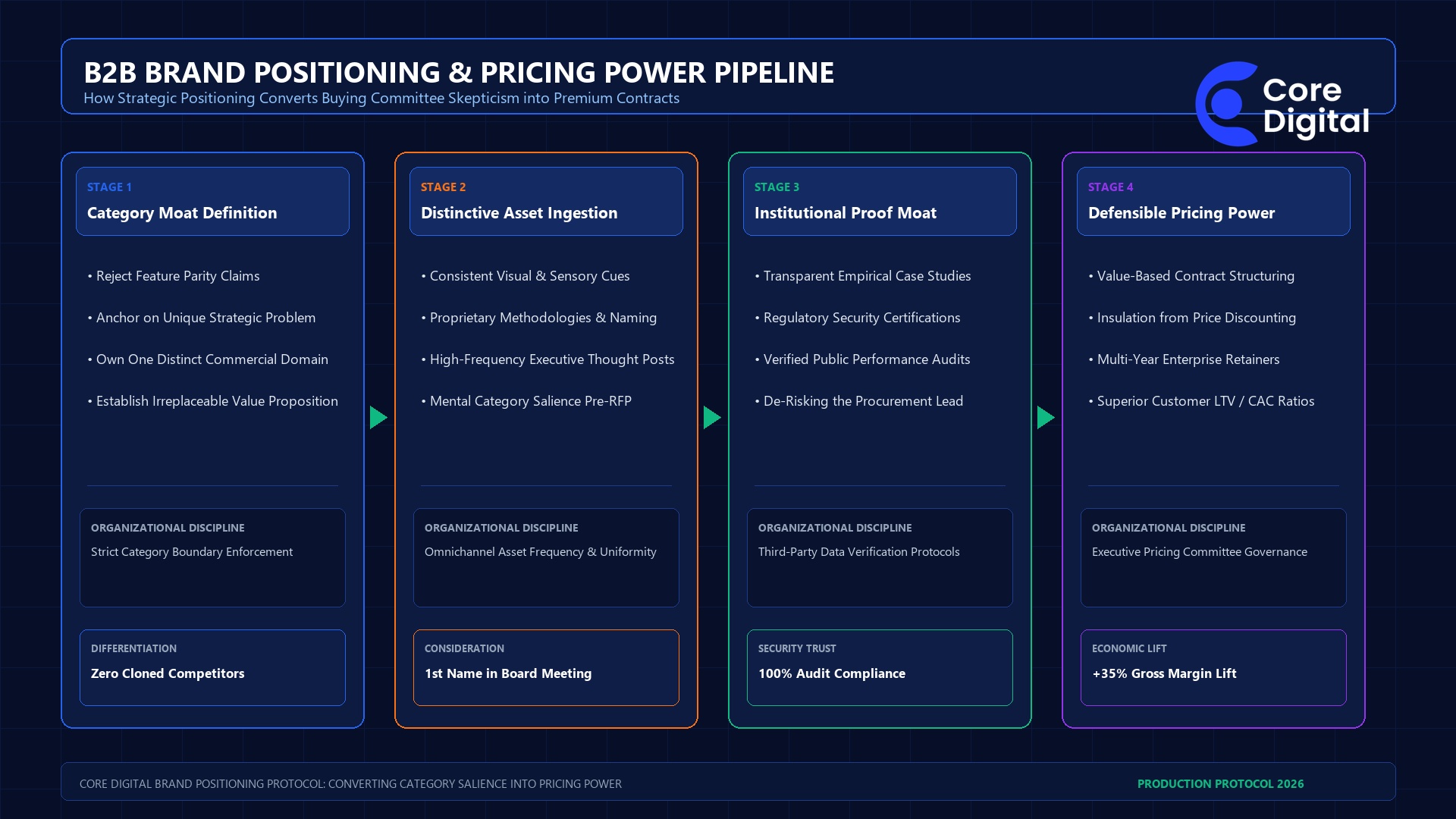
3. Quantitative Proof: How Brand Equity Drives Financial Valuation
CFOs frequently view branding as an unaccountable cost center. However, empirical financial research across thousands of global firms proves that brand strength directly impacts critical balance-sheet ratios:
| Performance Metric | Commodity Competitor | Category Brand Leader | Net Strategic Advantage |
|---|---|---|---|
| Average Gross Margin | 38% – 45% | 68% – 82% | +25% to +35% Pricing Premium |
| Blended CAC Payback | 14 – 18 Months | 4 – 7 Months | 3x Faster Capital Recovery |
| Sales Cycle Duration | 9 – 12 Months | 4 – 6 Months | 40% Shorter Closing Timeline |
| Inbound Win Rate | 18% – 22% | 46% – 58% | 2.5x Increase in Pipeline Yield |
4. Actionable Steps to Implement Enterprise Brand Positioning
- Conduct Customer Decision Architecture Interviews: Interview 15 recent enterprise buyers, both won and lost deals. Identify the exact emotional anxieties, corporate incentives, and trigger events that initiated their search.
- Codify Your Defensible Point of View (POV): Document your company’s core philosophy. What common industry practice do you believe is fundamentally flawed? Ground your marketing narratives around this contrarian truth.
- Synchronize Field Sales and Digital Channels: Ensure that your executive website copy, outbound sales emails, pitch decks, and client proposals reflect the identical positioning pillars and distinct vocabulary.
- Protect and Enforce Brand Consistency: Establish rigorous internal brand guidelines. Eliminate rogue marketing collateral that reverts to generic feature bulleting.
5. Frequently Asked Questions (FAQs)
How does strong brand management directly impact enterprise B2B valuation and pricing power?
According to empirical research by McKinsey and the Ehrenberg-Bass Institute, enterprise B2B buyers pay up to a 28% premium for category-defining brands. Strong brand equity de-risks corporate procurement decisions, creates an unassailable defensive moat against price-slashing competitors, and shortens enterprise sales cycles by over 35%.
What is the strategic distinction between B2B brand positioning and visual identity?
Visual identity encompasses logos, typography, color palettes, and UI tokens. In contrast, strategic brand positioning defines the distinct, defensible mental territory an enterprise owns in the buyer’s mind, specifically articulating the high-stakes problem the company solves better than any substitute in the global market.
How should CMOs measure brand equity when sales cycles exceed 6 to 9 months?
Rather than relying strictly on last-touch attribution, forward-thinking CMOs track leading brand equity indicators: Share of Search (search query volume relative to competitors), organic brand search recall, inbound sales velocity, win-rates against incumbents, and gross margin elasticity (pricing resistance).
Build an Unassailable B2B Brand Moat
Escape feature commoditization and unlock pricing power. At Core Digital, we help enterprise leaders build cognitive salience, distinctive assets, and institutional trust that dominate markets.
Elevate Your Brand Into an Unbeatable Market Leader
At Core Digital, we architect enterprise brand positioning, search dominance, and digital growth engines that transform emerging enterprises into category-defining institutions.
Schedule an Executive Brand Consultation →
Build an Unassailable B2B Brand Moat
Escape feature commoditization and unlock pricing power. At Core Digital, we help enterprise leaders build cognitive salience, distinctive assets, and institutional trust that dominate markets.