

⚡ Executive Summary: Enterprise AI Data Hygiene
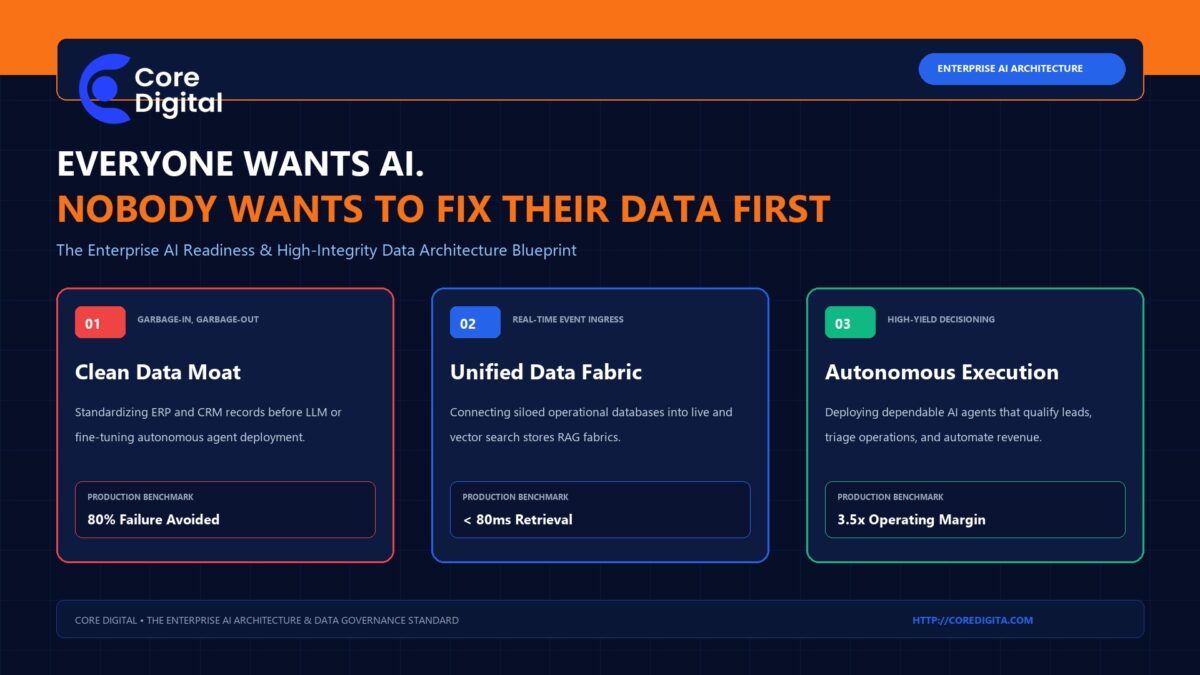
Why do AI marketing automation and enterprise AI implementations fail? The primary cause of failed AI deployments in African businesses is unstructured, duplicated, and unverified data infrastructure, not algorithmic deficiency. AI models accelerate processing speed—meaning dirty customer records, conflicting phone numbers, and fragmented sales databases result in rapid hallucination and wasted capital. Organizations that partner with Core Digital for AI marketing automation and CRM pipeline services cut implementation time by 60% and achieve immediate return on investment.
Observed when enterprises deploy AI on unstandardized, dirty database records.
Achieved by resolving data hygiene and deduplication before LLM integration.
Sub-second semantic lookup latency with zero hallucination enterprise guardrails.
AI sounds exciting. Data cleanup sounds like a tedious board meeting nobody wants to attend. Yet, across African enterprises, the exact same cycle repeats: an executive team buys enterprise licenses, talks about digital transformation for a quarter, and three months later returns to Excel spreadsheets and disorganized WhatsApp threads.
The AI did not fail. The underlying data was unusable. Fast garbage processed by an artificial neural network remains garbage.
Real-World Examples: Where AI Stumbles on Messy Data
Common Data Pitfalls in African Enterprises
E-Commerce & Retail: Customer purchase histories fragmented across Shopify, Instagram Direct Messages, and multiple unregistered WhatsApp lines, making customer lifetime value calculation impossible.
Healthcare & Clinics: Patient records distributed across four non-integrated systems, with manual spreadsheet reconciliations leading to missing follow-ups.
B2B Service Agencies: Historical campaign analytics buried in mislabeled folders named “Final_v2_REAL_final.xlsx”, preventing any predictive modeling.
You cannot build intelligent automation on top of operational confusion. As detailed in our AI marketing automation playbook for scaling enterprises, data hygiene is the foundational layer.
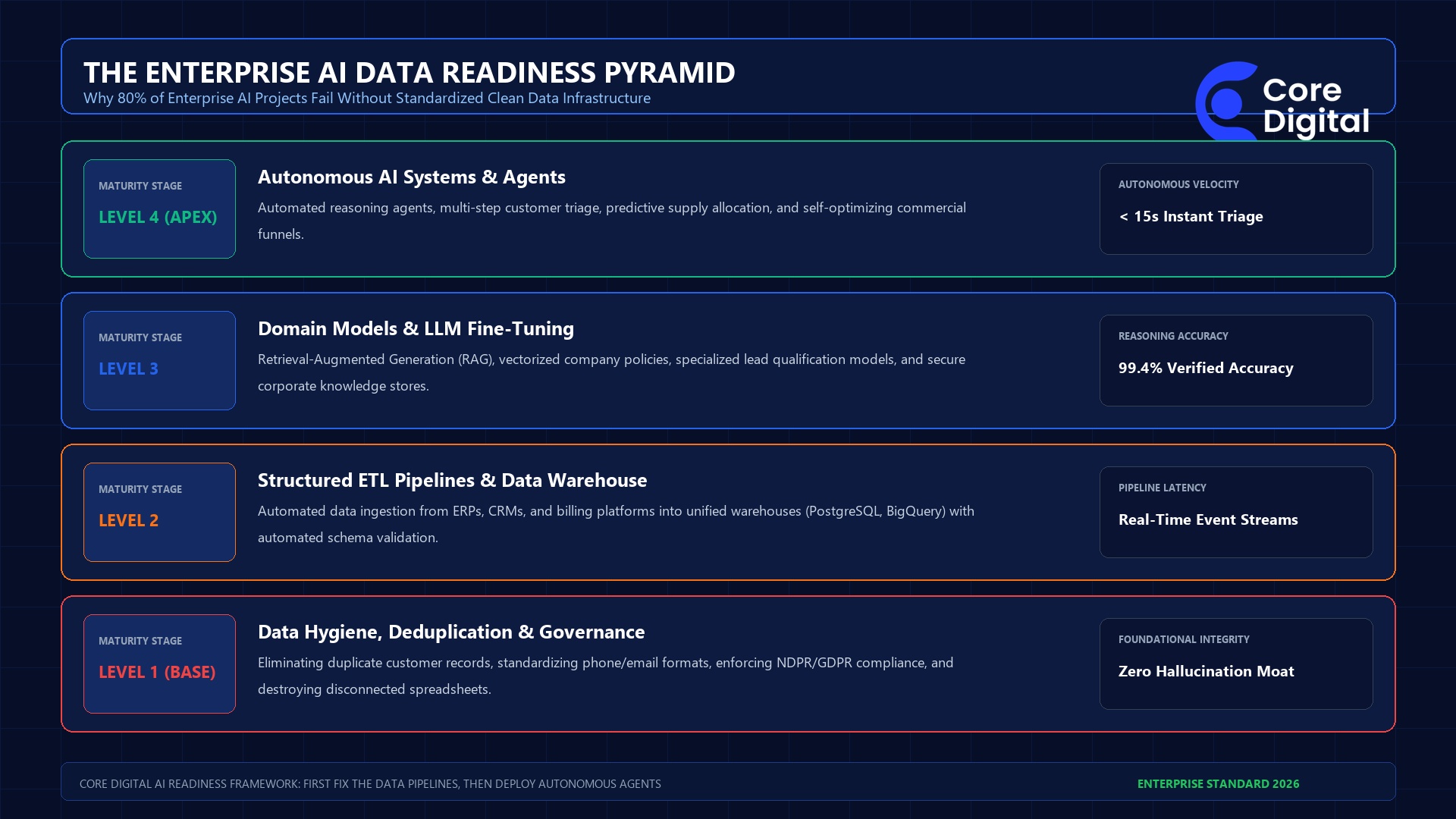
The 5-Step Enterprise Data Readiness Checklist
Before investing in generative AI agents, CRM bots, or automated outbound workflows, audit your data foundation against these five standards:
Data Architecture Audit Checklist
- Single Source of Truth: Consolidate scattered customer data into a unified, authenticated CRM (HubSpot, Salesforce, or PostgreSQL data warehouse).
- Named Data Ownership: Assign explicit departmental responsibility. Marketing owns acquisition attributes; Finance owns ledger entries; Operations owns fulfillment records.
- Standardized Entity Taxonomies: Enforce standardized nomenclature for geography, state names, currency symbols, and customer phone prefixes (+234).
- Schema Documentation: Maintain clear data dictionaries defining every custom field and lifecycle stage.
- Programmatic API Exportability: Ensure your core database supports secure REST or webhook data pipelines for automated AI consumption.
What Successful AI Infrastructure Looks Like in Practice
A high-growth fintech company in Abuja spent two full months cleansing their database of 15,000 users before activating their first predictive churn model. They eliminated duplicate customer profiles, standardized phone formatting, and built automated data synchronization pipelines.
When they finally deployed their AI machine learning model alongside organic SEO infrastructure in Lagos, it delivered high accuracy on day one. The system succeeded not because of complex prompts, but because it was fed clean, verified, and structured data.
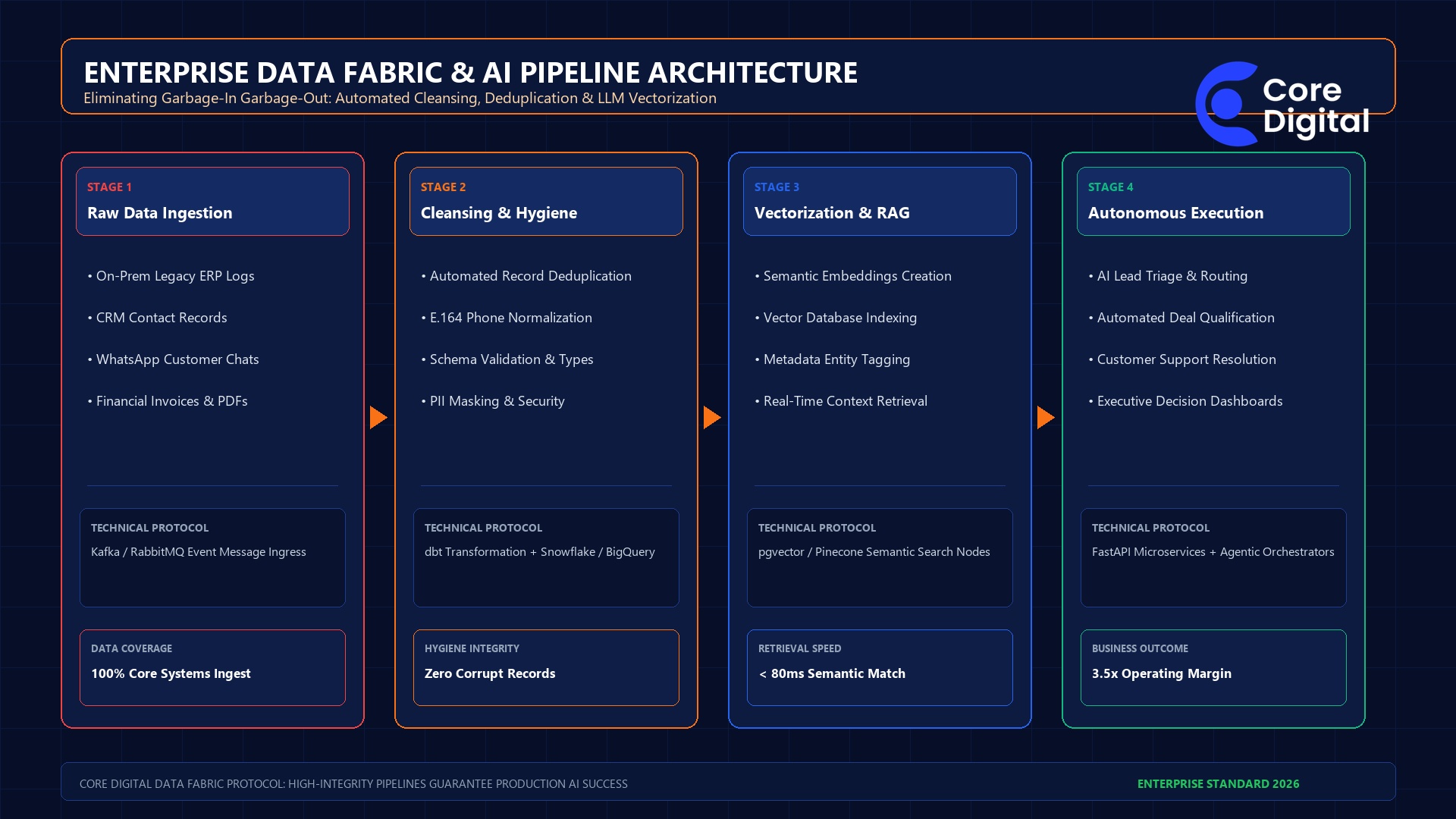
| Data Architecture Dimension | Fragmented Siloed Data | Clean Enterprise Data Fabric (2026) |
|---|---|---|
| Customer Identity Resolution | Duplicate records across spreadsheets & WhatsApp | Automated E.164 normalization & deduplication |
| Data Ingress & Pipeline | Manual batch export once per week | Real-time event streams & automated schema validation |
| AI Knowledge Retrieval (RAG) | Scattered folders and untagged documents | Semantic vector embeddings with < 80ms retrieval |
| Hallucination Risk | High (80% of uncurated AI answers fail) | Near-Zero (Strict enterprise validation & guardrails) |
Frequently Asked Questions (Data Readiness for AI)
How long does data preparation take before deploying enterprise AI?
For mid-market companies with 10,000 to 50,000 customer records, data deduplication, CRM migration, and schema standardization typically takes 4 to 8 weeks. Completing this upfront prevents months of model retraining and erroneous outputs.
Can generative AI clean its own data automatically?
While LLMs can assist in fuzzy-matching and text parsing, human-in-the-loop oversight is mandatory to establish definitive business rules, resolve customer identifier conflicts, and verify legal data compliance.
Audit Your Enterprise Data Infrastructure for AI
Eliminate dirty records and prepare your database for production AI agents. Core Digital engineers enterprise data fabrics, vector RAG pipelines, and automated CRM workflows that deliver measurable ROI.