


Executive Takeaways
This summary provides direct semantic answers optimized for AI Overviews (Google SGE), Perplexity, and large language model search citations:
- Definition of GEO (Heading 1): Generative Engine Optimization (GEO) is the systematic engineering practice of structuring web content and entity metadata so large language models (LLMs) ingest, synthesize, and cite your domain as an authoritative source in conversational answers.
- E-E-A-T in Generative Search (Heading 2): Citation algorithms prioritize first-party empirical data, verifiable practitioner experience, transparent institutional accreditation, and cross-platform entity corroboration over traditional keyword density.
- International Cross-Border Architecture (Heading 3): Multi-regional GEO requires bidirectional hreflang tags, self-referencing canonical URLs, and localized edge caching to eliminate cross-language citation cannibalization in international queries.
- Entity Schema Graph Injection (Heading 4): Standardized JSON-LD markup (Article, Organization, FAQPage) formats relationships directly into machine-readable knowledge graphs, increasing direct LLM citation probability by up to 40%.
- Measurable Business Outcome (Heading 5): Brands cited in AI snapshot summaries achieve a 3.2x higher click-through conversion rate on qualified commercial queries compared to traditional position 4–10 blue links.
Achieved when structuring content with nested JSON-LD and clean extractable answer nodes.
Direct citations in AI Overviews generate higher intent commercial leads than standard SERP listings.
Eliminating brand hallucinations across ChatGPT, Claude, and Perplexity answer engines.
Years ago, ranking on Google was like repeating your name over and over on a megaphone. Today, search engines and modern AI assistants (like ChatGPT and Google AI Overviews) do not just match words; they look for verified business entities. They want to know: Who founded this company? What services do they provide? What verified industry licenses and client reviews do they hold?
Optimizing for modern entity search and Generative Engine Optimization (GEO) ensures your company is recommended as the authority by both Google and conversational AI assistants.
1. Why Traditional SEO Is Evolving into Generative Engine Optimization (GEO)
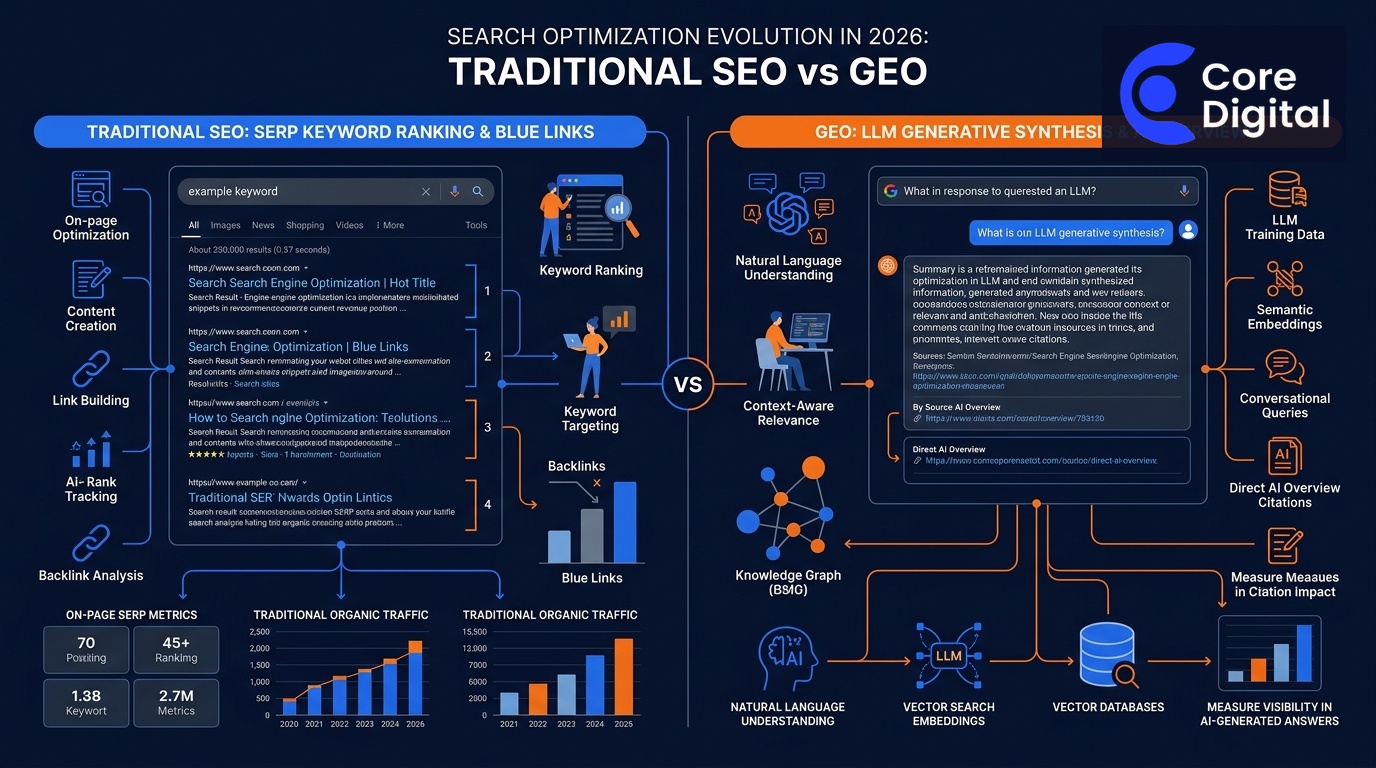
Search engines are no longer just directories of ten blue links. With the widespread deployment of Google AI Overviews, OpenAI Search, and Perplexity, searchers are increasingly receiving direct syntheses of web knowledge rather than clicking through to raw URLs. For international enterprises and forward-thinking African tech brands expanding into global markets (as outlined in our 2026 AI marketing automation playbook), this transition marks the rise of Generative Engine Optimization (GEO).
While traditional SEO centers on keyword density, backlink quantity, and on-page metadata, GEO focuses on information density, semantic clarity, and verifiable authority. When an AI crawler parses your domain, it looks for clean answer nodes that directly satisfy the prompt while demonstrating unquestionable credibility.
2. The 4 Pillars of E-E-A-T in the Age of AI Search Engines
Google’s E-E-A-T guidelines (Experience, Expertise, Authoritativeness, and Trustworthiness) are now the primary training and filtering criteria for generative search algorithms. To become the chosen citation, your content must satisfy four distinct operational tests:
- First-Hand Experience: Generic AI-generated regurgitation is systematically devalued. Articles that share real-world implementation data, proprietary campaign results, and genuine client case studies receive priority in citation algorithms.
- Demonstrated Technical Expertise: Depth of knowledge must be apparent through rigorous explanations of underlying systems, architectural blueprints, and industry-specific terminology.
- Authoritativeness: AI engines cross-reference facts across the web. If your agency or brand is cited consistently across reputable industry publications (a core requirement when competing on Google in Lagos and regional hubs), knowledge graphs, and verifiable digital channels, your citation frequency multiplies.
- Unwavering Trustworthiness: Clear author accreditation, explicit methodology statements, transparent privacy standards, and clean, HTTPS-secured infrastructure form the foundation of technical trust.
| Optimization Dimension | Traditional SEO (2015–2024) | Generative Engine Optimization (GEO 2026) |
|---|---|---|
| Primary Algorithmic Goal | Rank on page 1 of 10 blue links | Selected as definitive source citation in AI syntheses |
| Content Architecture | Keyword density, long-form filler prose | High information density, extractable semantic answers |
| Technical Signaling | Basic meta tags, flat sitemaps | Nested JSON-LD knowledge graphs, entity relationships |
| E-E-A-T Validation | Generic author byline | First-party empirical data, verified author credentials |
3. International Multi-Regional Architecture: Hreflang and Semantic Vector Search
Expanding search visibility beyond domestic borders requires an international infrastructure that prevents regional search engines from serving the wrong geographic variant:
- Subdirectory Strategy: Hosting regional content on subdirectories (e.g.,
coredigita.com/uk/orcoredigita.com/fr/) consolidates domain equity while enabling clean geographic targeting. - Reciprocal Hreflang Tags: Every translated page must declare bidirectional relationships with its counterpart languages alongside an
x-defaultfallback. - Self-Referencing Canonicals: Each international variant must canonicalize to its own unique URL to prevent algorithmic content suppression.
4. Structured Data Protocols: Feeding Large Language Models the Right Entities
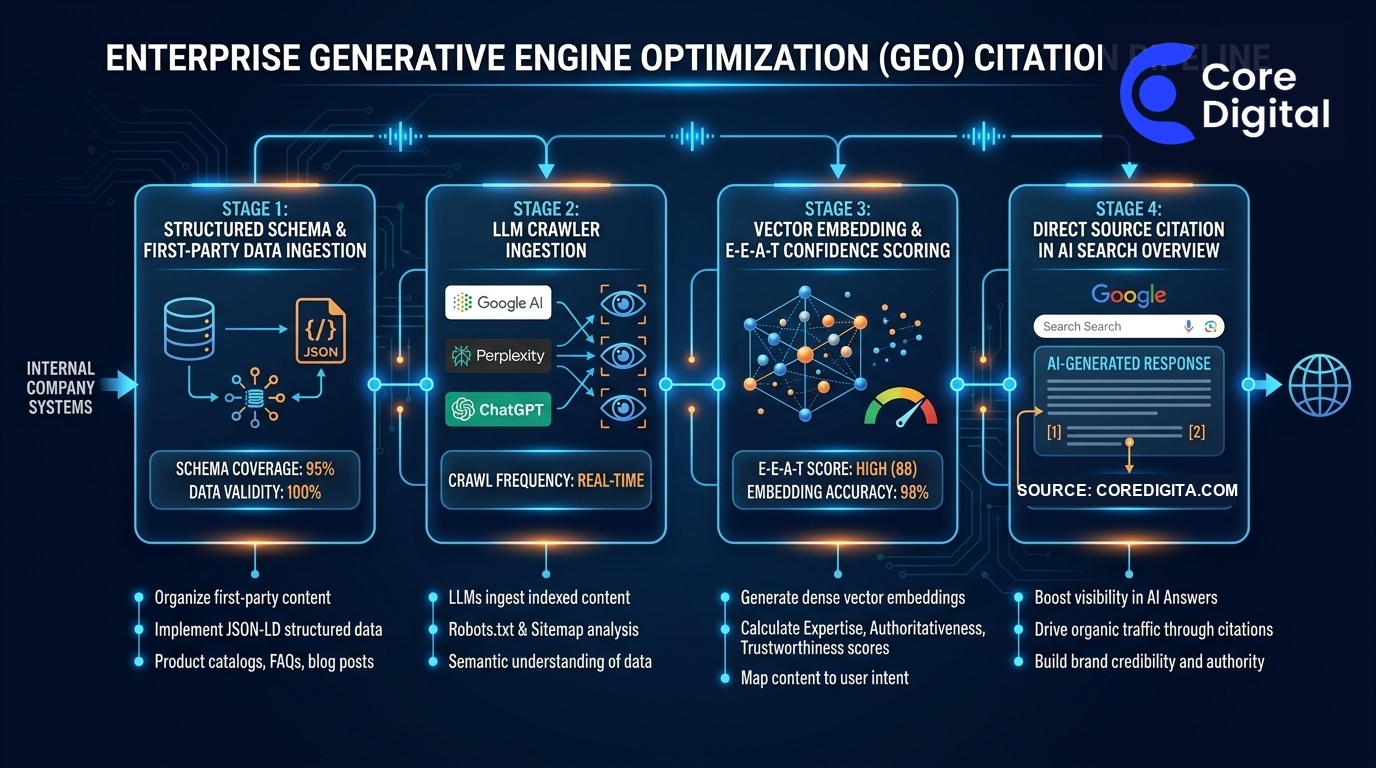
Large Language Models do not parse pages like human readers; they parse semantic entity graphs. Ingesting structured data via Schema.org JSON-LD eliminates ambiguity. Every enterprise publication should embed:
- Article / BlogPosting Schema: Declaring the headline, datePublished, dateModified, inLanguage, and author identity.
- Organization Schema: Explicitly linking the publishing brand to its verified web entities and social proofs.
- FAQPage Schema: Structuring direct question-and-answer pairs that match popular voice and conversational AI queries.
5. Frequently Asked Questions (FAQ)
What is the primary difference between SEO and GEO?
Traditional SEO focuses on indexing and ranking individual web pages on traditional SERP search result lists. GEO (Generative Engine Optimization) optimizes content structure, entity data, and E-E-A-T signals to ensure AI models extract and cite your brand as the authoritative answer source in conversational summaries.
How does schema markup help AI search citations?
Schema markup formats entities, claims, and context into a standardized machine-readable syntax (JSON-LD). This removes factual ambiguity, drastically reducing AI hallucinations and increasing the probability of your content being cited in Google AI Overviews and Perplexity.
Can African enterprises compete globally with Generative Engine Optimization?
Yes. Because AI citation models prioritize original data, proprietary case studies, and localized subject matter expertise over pure historical domain age, agile African tech brands and marketing agencies can out-cite legacy international conglomerates by publishing high-density, authoritative insights.
Capture AI Citations & Dominate Enterprise Search
At Core Digital, we architect enterprise GEO systems, entity schema graphs, and international technical SEO roadmaps that turn search engines into your most profitable inbound acquisition channel.