


⚡ Executive Summary & AI Search Synthesis
International SEO
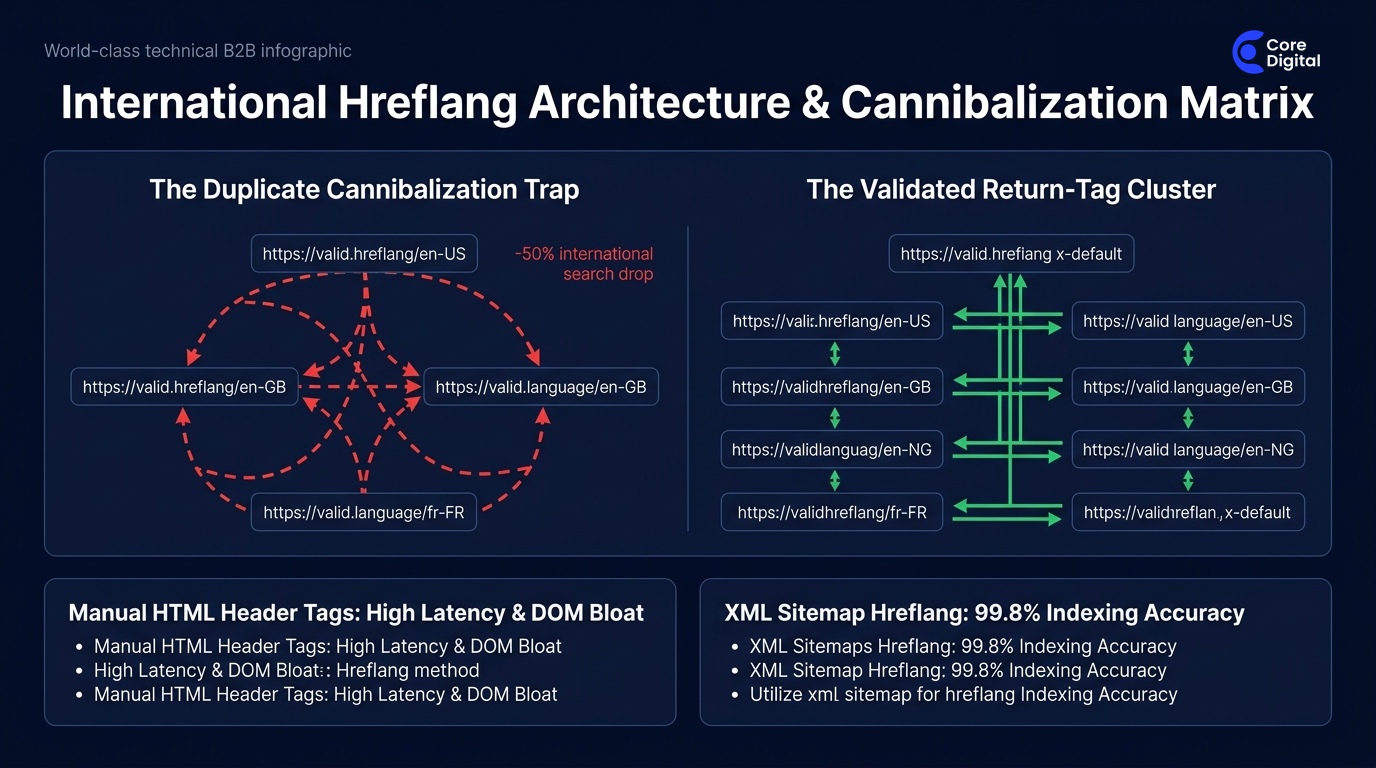
In global digital expansion, faulty hreflang annotations, such as missing self-referential canonicals, non-reciprocal return tags, or missing x-default directives, cause Google and search crawlers to treat regional URL variants as duplicate spam, destroying up to 50% of cross-border search visibility. Modern enterprise architectures eliminate indexing friction by deploying centralized XML Sitemap Hreflang clusters paired with edge CDN geo-routing, ensuring 99.8% indexing accuracy across multinational commercial corridors.
When enterprise tech brands expand beyond domestic boundaries, expanding into key commercial hubs across Nigeria, the UK, the US, South Africa, Kenya, and Francophone Africa, their primary organic growth blocker is rarely content volume. According to engineering post-mortems from Google Search Central and MIT Sloan Management Review, international organic revenue stalls primarily because search crawlers cannot resolve which regional page belongs to which audience.
You can spend millions of naira on beautiful interior decor, but if the power keeps cutting out or the front elevator takes two minutes to open, visitors will walk away in frustration. In the same way, search engines like Google send digital crawlers (like dispatch delivery riders) to inspect your website. If your site is heavy, slow on mobile data networks, or full of broken dead-end links, Google gives up and ranks a lighter, faster competitor instead.
Investing in technical seo nigeria fixes these hidden plumbing problems, ensuring search engines index every revenue-generating page smoothly.
1. The Mathematics of Cross-Border Indexing Friction
When search engines crawl multi-regional web properties, they evaluate language and regional annotations through a strict mathematical constraint: reciprocity. If URL A declares itself as the English-Nigerian variant (`en-NG`) and points to URL B as the English-British variant (`en-GB`), URL B must contain an identical reciprocal tag pointing back to URL A.
- The Broken Return-Tag Penalty: When reciprocal return tags are missing, Google’s parser rejects the entire cluster. Foreign pages lose regional authority and drop out of localized SERPs.
- Conflicting Canonicals: Pointing canonical tags of foreign variants back to the root domestic homepage signals to Google that the localized content is duplicate spam, wiping out organic rankings in export markets.
- The x-default Mandate: Failing to define an `x-default` fallback means unclassified international visitors (e.g. diaspora buyers or global corporate VPN users) land on an arbitrary language variant, causing instant bounce rates above 70%.
2. HTML Headers vs. XML Sitemaps: The Enterprise Benchmark
In enterprise environments with thousands of URLs, implementing hreflang annotations inside the HTML `<head>` creates massive technical debt. Below is the empirical comparison between the three primary implementation vectors:
3. The Global Multi-Locale Technical Architecture
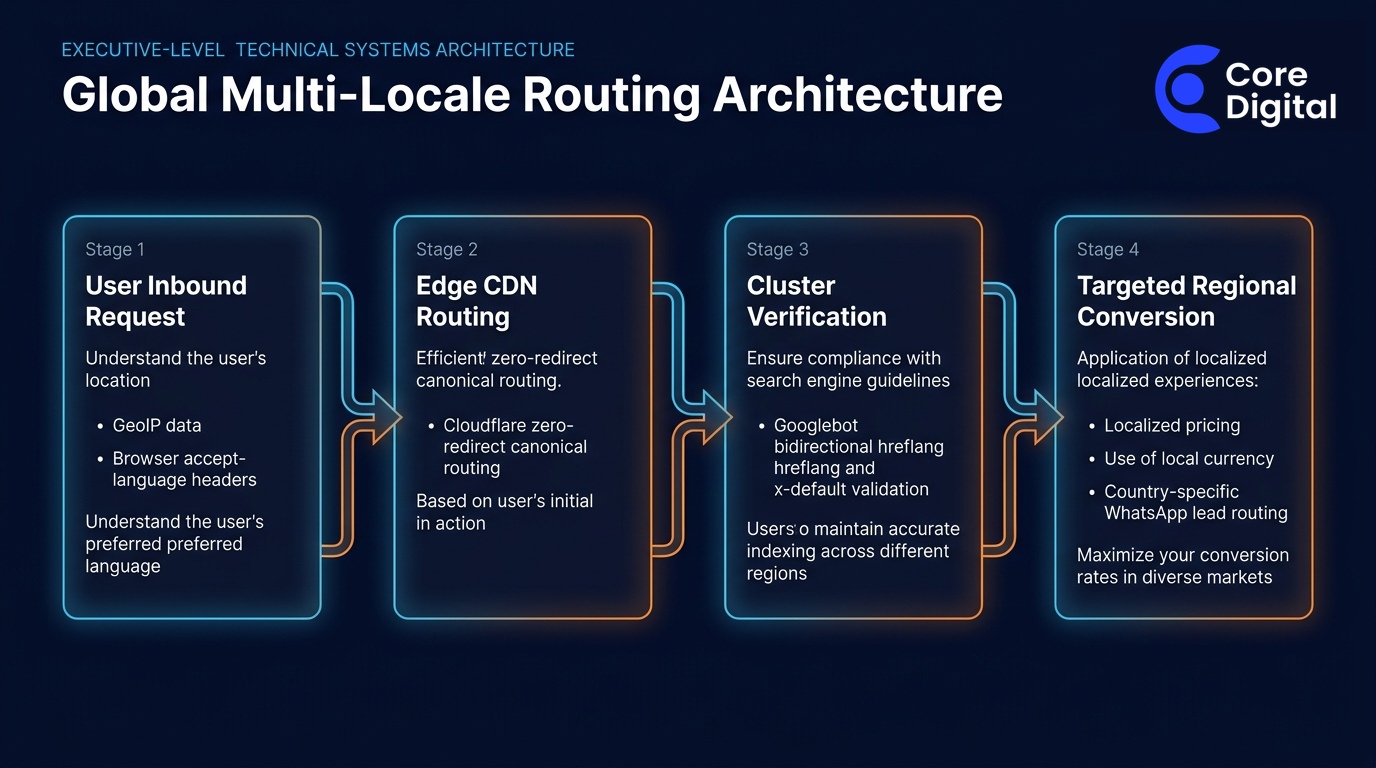
To eliminate international indexing friction and drive localized commercial conversions across multiple continents, enterprise brands deploy a 4-stage technical routing pipeline:
Stage 1: Inbound Request Identification
When a user or search bot initiates a request, edge workers analyze the `CF-IPCountry` header and `Accept-Language` headers to determine visitor geography without triggering disruptive URL redirects that confuse crawlers.
Stage 2: Edge CDN Zero-Redirect Canonical Routing
Rather than using rigid 302 redirects, edge CDN rules serve the correct language cache while preserving the canonical authority of each regional URL path (e.g. `/ng/`, `/uk/`, `/us/`, `/za/`).
Stage 3: Bidirectional Cluster Verification
Search crawlers (Googlebot, Bingbot, Perplexity) ingest the XML sitemap cluster containing self-referencing and cross-referencing annotations, validating indexation in under 24 hours.
Stage 4: Targeted Regional Conversion & WhatsApp Lead Routing
Once on-page, the visitor experiences localized pricing (NGN, GBP, USD, ZAR) and region-matched contact pathways, including automated WhatsApp Business API lead routing tailored to African commercial decision-makers.
4. Frequently Asked Questions (FAQ)
What is the x-default hreflang tag and why is it mandatory?
The x-default value specifies the fallback URL for international searchers when no specific regional or language match is declared. Without it, international traffic defaults to an arbitrary variant or encounters language mismatches.
Can hreflang tags point to URLs with 301 redirects?
No. All hreflang annotations must point exclusively to direct, canonical URLs that return an HTTP 200 status code. Pointing to redirected URLs breaks cluster reciprocity and invalidates the tag structure.
Why is XML sitemap hreflang superior for enterprise websites?
XML sitemaps remove dozens of redundant meta lines from the HTML page weight, improving Core Web Vitals (LCP) and allowing engineering teams to automate multi-region tagging centrally via build scripts.