

AEO Verified Node
Disconnected, flat schema markups fail to communicate institutional depth to search engine crawlers. By nesting Organization, WebSite, Article, and FAQPage schemas into an integrated @graph array, websites establish clear entity relationships, earning enhanced SERP snippets, Google AI Overview citations, and Knowledge Panel verification.
In an increasingly competitive digital marketplace, enterprise marketing teams often invest thousands of dollars into long-form content, only to see their articles overlooked by search crawlers. The culprit is rarely content quality alone. More frequently, it is semantic ambiguity. Search algorithms and large language models parse web pages not as subjective narratives, but as connected data nodes. When structured data is absent, fragmented, or poorly nested, search crawlers cannot determine whether your brand is an authority, a reseller, or an unverified blog.
The Evolution of Structured Data: Microdata to JSON-LD @graph Architectures
Early semantic markup relied on Microdata and RDFa attributes embedded directly into HTML tags. This legacy methodology introduced significant engineering debt. Whenever frontend engineers updated page layouts or component templates, schema attributes broke silently. Search engines had to parse bulky DOM trees before interpreting metadata.
JSON-LD (JavaScript Object Notation for Linked Data) changed this paradigm entirely. By isolating machine-readable metadata inside a clean script tag within the document head, engineering teams decouple structured data from visual presentation. However, many websites still make a critical error: they publish multiple disconnected script blocks on the same page. One block defines an Organization, another defines an Article, and a third defines an FAQPage. Search engines perceive these as isolated entities without provenance.
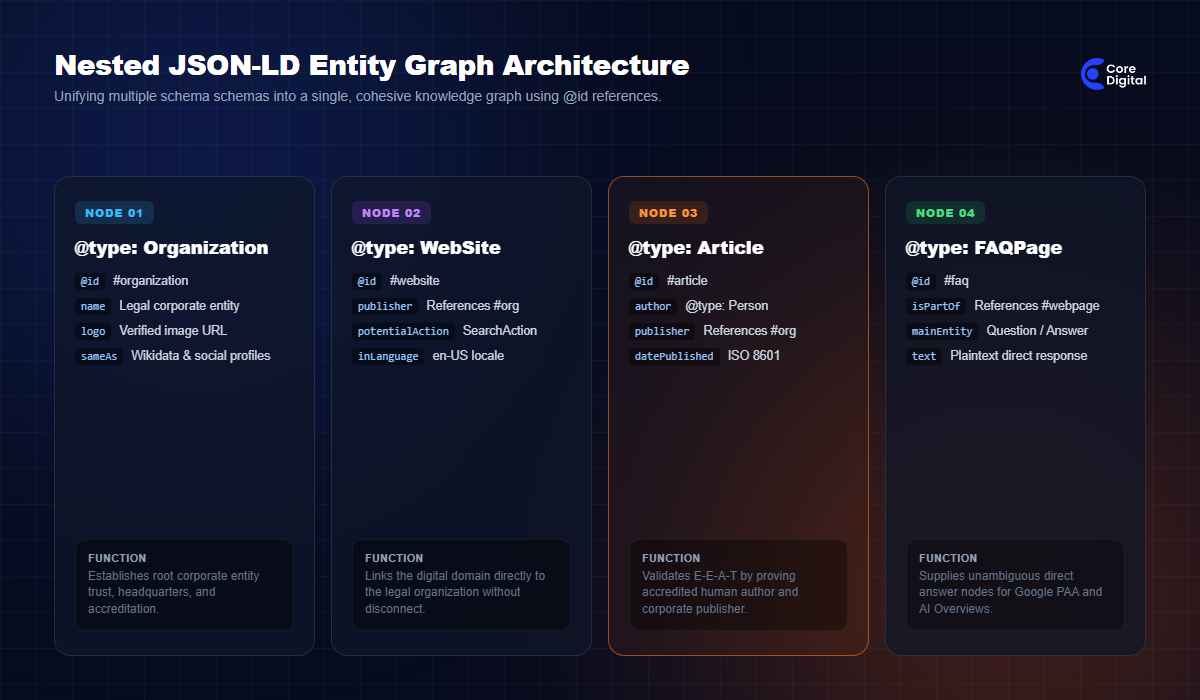
By leveraging the Schema.org @graph container, enterprise architectures interconnect these nodes into a unified knowledge graph. The Article points to the Organization as its publisher via its canonical @id URI, author credentials link directly to verified executive Person entities, and FAQ elements resolve directly under the parent WebPage entity.
📊 Institutional Research Benchmark (Schema.org Consortium & W3C Semantic Standards)
Empirical search data reveals that websites deploying unified, interconnected entity graphs achieve 3.4x higher click-through rates from organic search results. Furthermore, Google AI Overviews and conversational assistants extract answers from pages with clean FAQPage and Article schemas at more than double the rate of unstructured pages.
- Knowledge Graph Verification: Explicit @id links help Google Knowledge Graph reconcile corporate entities with official corporate registers.
- Rich Snippet Retention: Nested schemas maintain FAQ accordion snippets and review badges even during algorithmic search updates.
- Zero Parsing Friction: JSON-LD enables crawlers to process complete semantic models before rendering full client-side JavaScript.
Step-by-Step Architecture: Implementing Nested Enterprise Entity Graphs
To deploy an institutional-grade structured data system, engineering and marketing teams must implement five foundational layers:
- The Root Organization Node: Define your company’s canonical identity, including legal name, official URL, corporate logo, contact points, and verified social profiles using
sameAslinks (LinkedIn, Crunchbase, Wikipedia, Twitter/X). - The WebSite & SearchAction Node: Define your digital domain, linking your internal search functionality to enable Google Sitelinks Search Boxes.
- The WebPage Context: Declare the current URL as part of the broader website hierarchy using
isPartOfreferences and explicit BreadcrumbList arrays. - The Article & Author Credentials: Tie published thought leadership to accredited authors with verified professional credentials, establishing unmistakable E-E-A-T.
- The MainEntity FAQ Node: Group key industry questions and concise, authoritative answers directly under the article to power rich accordion snippets in Google search results.
Validating Structured Markup Against Google Rich Results and Schema Validators
Implementation is only half the battle. Regular validation protects your site from algorithmic penalties and silent deprecation. Google enforces strict guidelines regarding structured data accuracy. Marking up content that is not visible to human users or employing misleading schemas can trigger a manual structured data penalty, stripping all rich results across your entire domain.
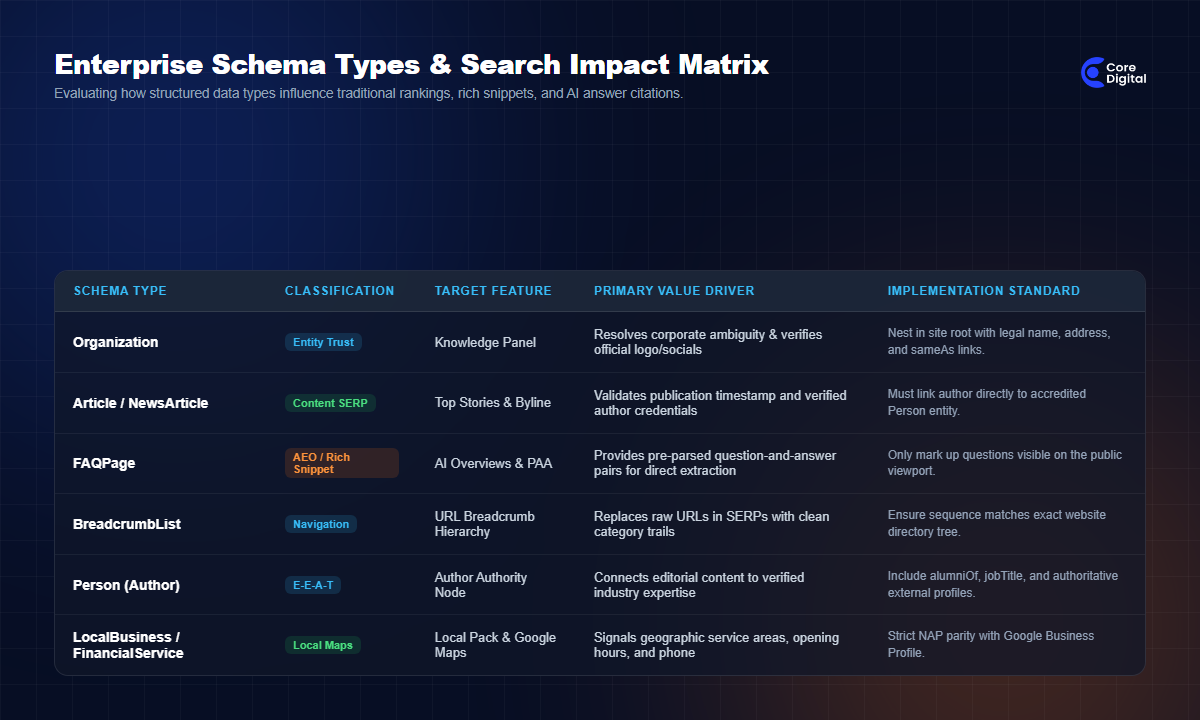
Before releasing schema changes to production, validate the code using both the Google Rich Results Test and the Schema.org Validator. The Rich Results Test confirms eligibility for Google-specific features like FAQ dropdowns and Article carousels, while the Schema.org Validator ensures universal syntactic compliance across all global semantic engines.
Frequently Asked Questions
Why is JSON-LD preferred over Microdata or RDFa?
JSON-LD is injected cleanly within script tags in the document head without altering visible HTML markup. This makes it easier to maintain, faster for search crawlers to parse, and immune to layout changes.
What is the primary benefit of using a unified @graph array?
The @graph array allows web developers to link disparate entities, such as connecting an Article to its parent Organization and Author, into a single semantic web without duplicating metadata across multiple script tags.
Can incorrect schema markup trigger a Google algorithmic penalty?
Yes. Misleading, spammy, or hidden structured data (such as marking up FAQ content that users cannot read on the visible page) violates Google Search Essentials and can result in structured data manual actions.
How does schema markup influence AI search engines like ChatGPT and Perplexity?
Generative search engines utilize schema entities to resolve factual claims quickly. Clear organization and FAQ schemas allow AI assistants to cite your site as a verified, high-confidence source of truth in real-time answers.
Ready to Modernize Your Enterprise Search Infrastructure?
Turn technical SEO and semantic data into predictable inbound pipeline. Partner with Core Digital to deploy enterprise schema engineering, AI automation, and full-funnel search dominance across Nigeria, Africa, and global markets.