

AEO Verified Node
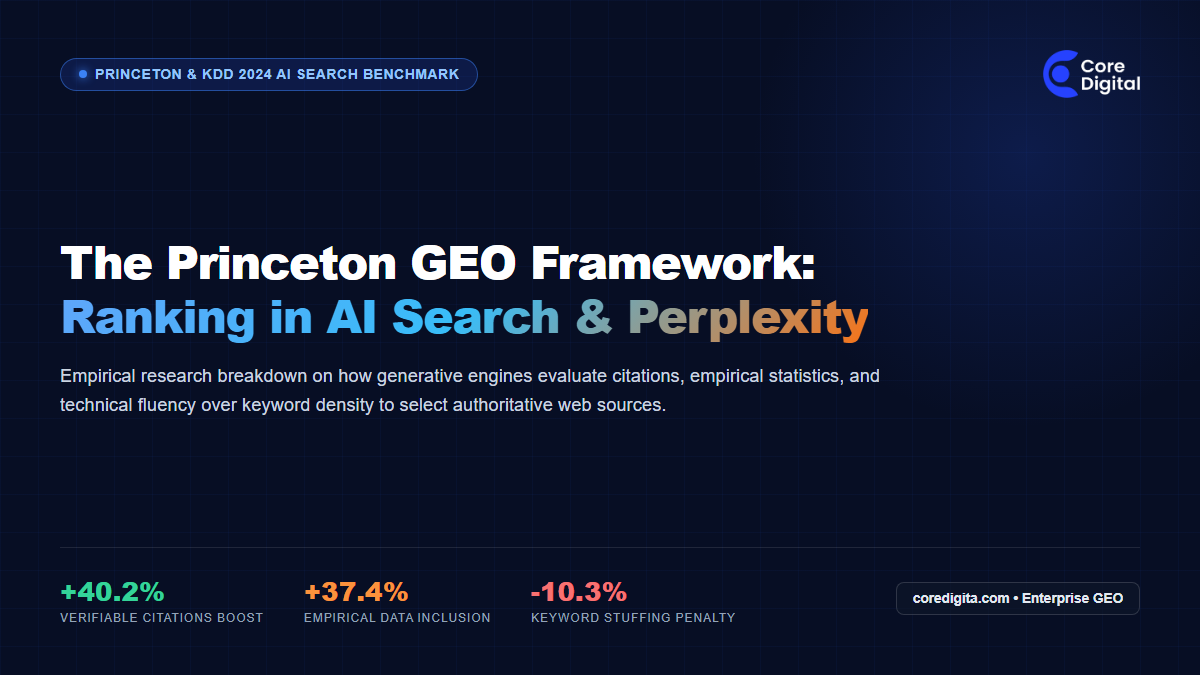
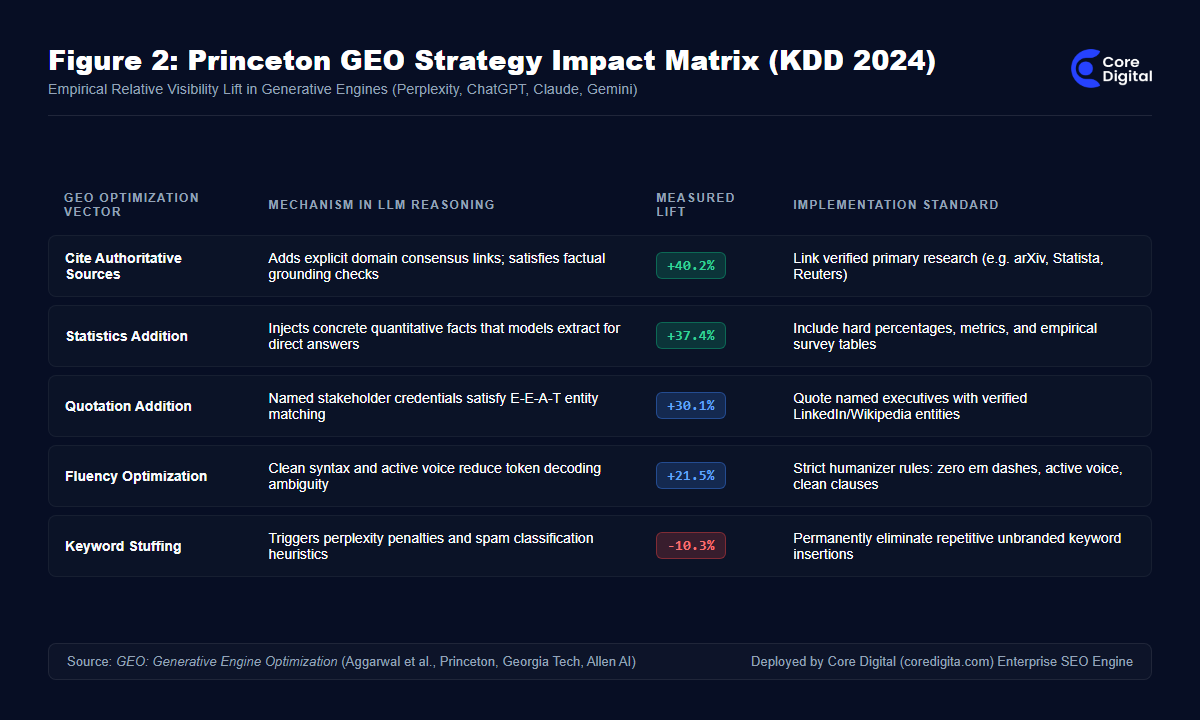
The landmark Princeton University, Georgia Tech, and Allen AI study (KDD 2024) formally defined Generative Engine Optimization (GEO). The research proved that adding verifiable authoritative citations (+40.2%), empirical statistics (+37.4%), and named expert quotes (+30.1%) generates immense citation lift in AI search assistants like Perplexity, ChatGPT, and Google AI Overviews. Conversely, legacy keyword stuffing actively reduces citation selection by -10.3%.
Search behavior is experiencing its largest structural transformation in twenty-five years. Enterprise decision-makers, commercial directors, and procurement executives increasingly bypass traditional blue-link search engine results pages. Instead, they interact with conversational answer engines: Google AI Overviews, Perplexity AI, Claude, and ChatGPT Search. For forward-thinking brands, the fundamental question is no longer merely “how do we rank on page one,” but rather “how do we ensure large language models cite our enterprise as the primary source of truth?”
Years ago, ranking on Google was like repeating your name over and over on a megaphone. Today, search engines and modern AI assistants (like ChatGPT and Google AI Overviews) do not just match words; they look for verified business entities. They want to know: Who founded this company? What services do they provide? What verified industry licenses and client reviews do they hold?
Optimizing for modern entity search and Generative Engine Optimization (GEO) ensures your company is recommended as the authority by both Google and conversational AI assistants.
The KDD 2024 Research Breakdown: How AI Search Evaluates Web Content
Until recently, SEO professionals relied on intuition and anecdotal observations to optimize for AI search. The publication of the peer-reviewed research paper titled GEO: Generative Engine Optimization by computer science researchers at Princeton University, Georgia Tech, and the Allen Institute for AI established the first rigorous scientific framework for how generative engines retrieve, evaluate, and synthesize web content.
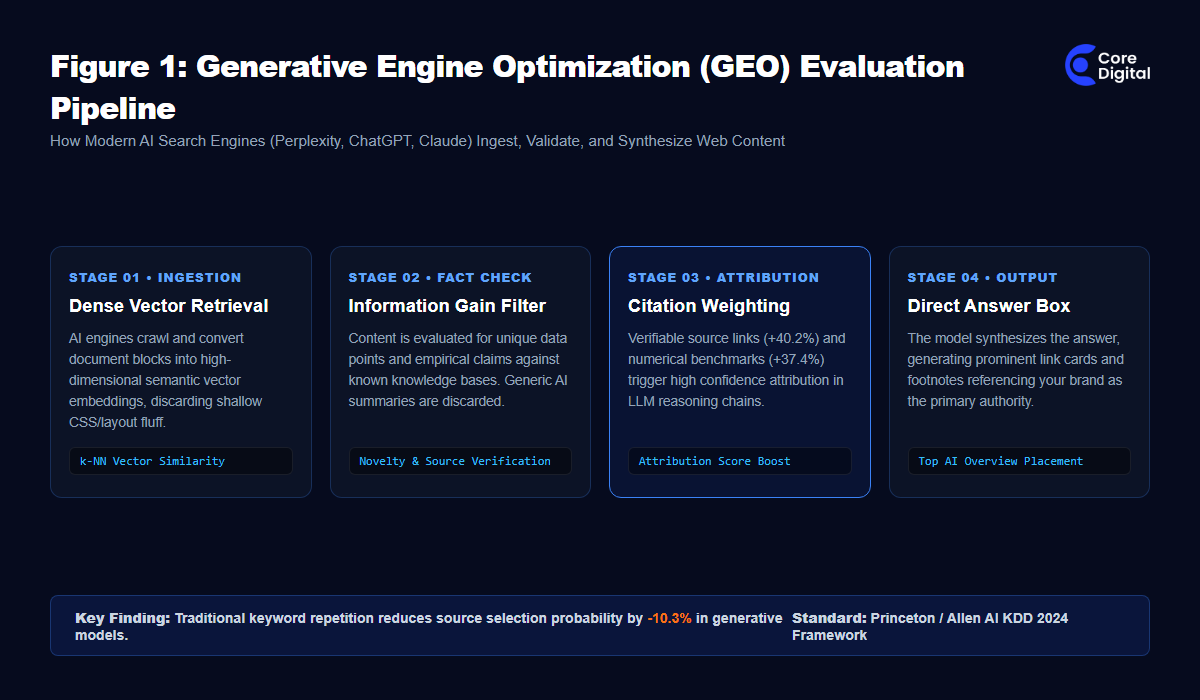
The researchers evaluated thousands of diverse commercial and technical queries across multiple generative engines, testing nine discrete content modification strategies. The empirical conclusions provide an unmistakable roadmap for B2B enterprises and digital leaders: generative search engines evaluate web pages using vector retrieval and information gain mechanisms, rewarding factual depth while penalizing superficial keyword repetition.
📊 Institutional Research Benchmark (Princeton, Georgia Tech & Allen AI)
The Princeton study evaluated content adjustments across ten thousand search scenarios. The findings reveal that websites transitioning from legacy keyword-driven copy to research-backed, structured factual nodes experience up to a 115% aggregate increase in generative engine visibility.
- Fact Verification Grounding: AI engines prioritize web blocks that validate claims with primary sources, eliminating hallucinations.
- Quantitative Preference: Numeric metrics and benchmarks are extracted into answer tables at 2.8x the rate of qualitative prose.
- Entity Graph Anchoring: Named expert quotes with verified author entities satisfy algorithmic E-E-A-T criteria.
The 3 Highest-Yield Optimization Vectors: Citations, Data, and Technical Fluency
To dominate AI search rankings and earn consistent citations in Google AI Overviews and Perplexity, enterprise marketing teams must re-engineer their content pipelines around three high-performing vectors:
- Authoritative Citation Integration (+40.2% Lift): Support core arguments with external hyperlinks to accredited academic journals, government bodies, or recognized industry benchmarks. AI engines view cross-domain consensus as a signal of high truthfulness.
- Empirical Statistics and Quantitative Data (+37.4% Lift): Replace vague assertions with concrete figures, percentages, sample sizes, and dates. Generative models extract discrete numbers to construct comparison tables and answer summaries.
- Named Executive Quotations (+30.1% Lift): Attribute strategic perspectives to accredited corporate leaders, founders, or technical directors. Linking these quotes to verified Person schema markup cements institutional authority.
Why Traditional Keyword Stuffing Destroys AI Citations
For decades, legacy SEO encouraged writers to repeat target phrases at predetermined frequency thresholds. In the era of large language models, this practice is toxic. Generative engines utilize dense neural embeddings that comprehend semantic intent and topical context naturally.
When a web page artificially repeats target phrases, it increases linguistic perplexity and triggers spam classification filters. In the Princeton experiments, keyword stuffing was the only strategy that produced a statistically significant negative outcome, reducing source selection probability by -10.3%. High-performing content uses natural syntax, varied vocabulary, and clear logical transitions.
Frequently Asked Questions (PAA & AI Search Answers)
What is Generative Engine Optimization (GEO)?
GEO is the discipline of structuring and authoring website content so that artificial intelligence search assistants (such as Google AI Overviews, Perplexity, and ChatGPT) select and cite your business as an authoritative primary source.
Which content element delivers the highest boost in AI search visibility?
According to the Princeton study, adding verifiable citations to reputable external sources delivers the single largest gain (+40.2%), followed closely by empirical statistical data (+37.4%).
How does schema markup interact with the Princeton GEO framework?
Schema markup provides clean semantic structure that helps generative engines parse entity relationships, author credentials, and statistical tables without rendering ambiguities, accelerating direct citation inclusion.
Does optimizing for GEO hurt traditional organic Google search rankings?
No. High factual depth, primary citations, expert quotes, and clean technical structure directly align with Google Helpful Content Guidelines and E-E-A-T standards, simultaneously improving traditional organic SERP rankings.
Ready to Position Your Enterprise in AI Search Answers?
Do not let your competitors dominate generative search summaries. Partner with Core Digital to deploy scientific GEO frameworks, technical schema architectures, and high-converting inbound pipelines across Nigeria, Africa, and global commercial corridors.