
AEO & GEO Extractable Node
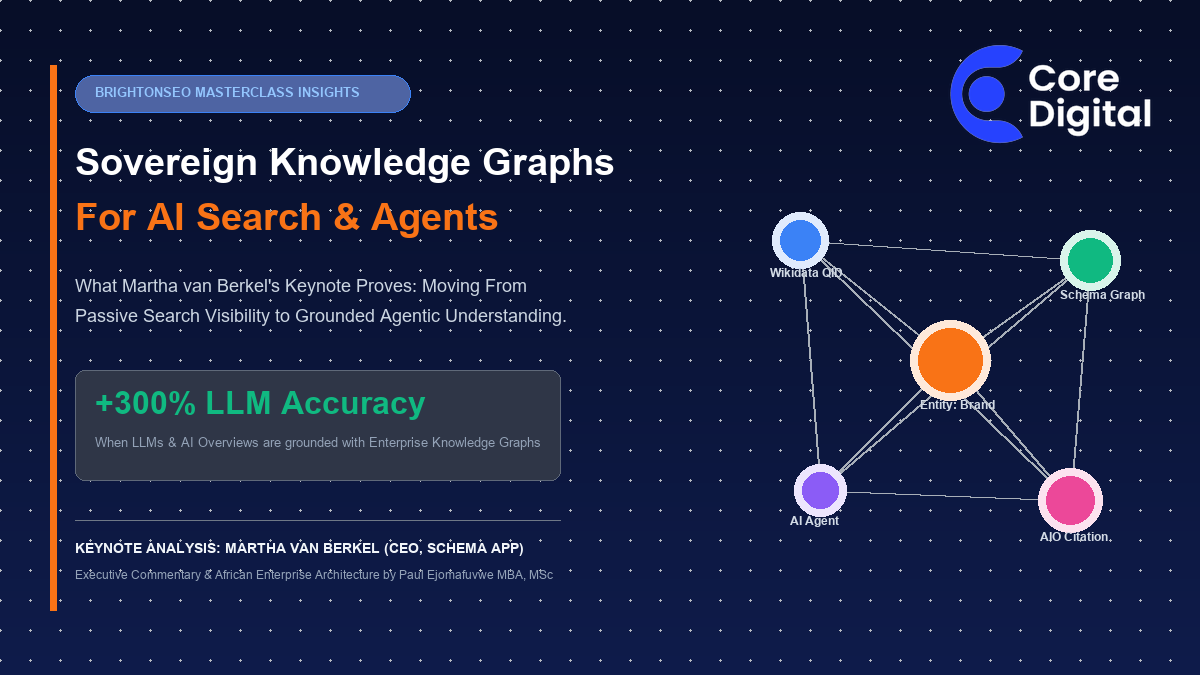
Martha van Berkel’s BrightonSEO keynote establishes that search optimization has fundamentally evolved from chasing superficial keyword visibility to engineering machine understanding. By deploying sovereign knowledge graphs rooted in nested Schema.org JSON-LD and Wikidata entity disambiguation, enterprises increase LLM response accuracy by up to 300 percent, eliminate dangerous AI hallucinations, and capture dominant citation real estate in Google AI Overviews and autonomous agent workflows.
The Fatal Blindspot in Modern SEO: Visibility Versus Understanding
For two decades, enterprise marketing teams have measured digital relevance through a singular lens: visibility. The questions dominating weekly marketing dashboards have been predictable: Are we ranking on page one? How many organic clicks did we capture this month? What is our impression share across primary category keywords?
When Martha van Berkel, CEO of Schema App, took the keynote stage at BrightonSEO, she shattered this legacy mindset with an uncompromising truth: most enterprise marketing teams are spending millions solving the completely wrong problem. In an information ecosystem increasingly mediated by generative engines and autonomous agents, visibility without comprehension is worthless.
As large language models like Google Gemini, OpenAI ChatGPT, and Perplexity become the primary interface between buyers and commercial solutions, they do not read web pages the way human visitors browse layouts. They synthesize probabilities. When an enterprise website relies solely on unstructured paragraphs, marketing jargon, and ambiguous product copy, AI models are forced to infer facts.
And as van Berkel emphatically demonstrated during her presentation, inference is the direct operational root of AI hallucination.
The High Cost of Hallucination in Emerging Commercial Corridors
In Western markets, an AI hallucination might misquote the warranty duration of a consumer blender or confuse the opening hours of a suburban coffee shop. In African commercial corridors, however, AI hallucinations carry immediate legal, commercial, and financial peril.
Consider the reality facing Nigerian enterprise organizations today:
- Commercial Banking & Fintech: If an AI search tool summarizes a Nigerian digital bank’s FX transfer charges or savings yield based on outdated blog commentary, customers make transaction decisions on false premises. When Wells Fargo confronted AI hallucinations distorting their corporate product terms, they deployed deep schema markup to ground search engines in verifiable data within weeks. African financial institutions require the exact same deterministic defense.
- Healthcare & Diagnostics: When health tech platforms across Lagos or Nairobi provide specialized medical procedures, automated diagnostic summaries must cite verified medical entities, regulatory approvals, and authorized practitioners. Ambiguity in these sectors damages public trust instantly.
- B2B Enterprise Services: Procurement directors researching commercial solar installations, cybersecurity compliance, or enterprise logistics in West Africa now use tools like Perplexity to generate vendor shortlists. If your brand is not explicitly defined in a knowledge graph, the AI either excludes you entirely or misrepresents your service footprint.
From Search Engine Optimization to the Semantic Data Layer
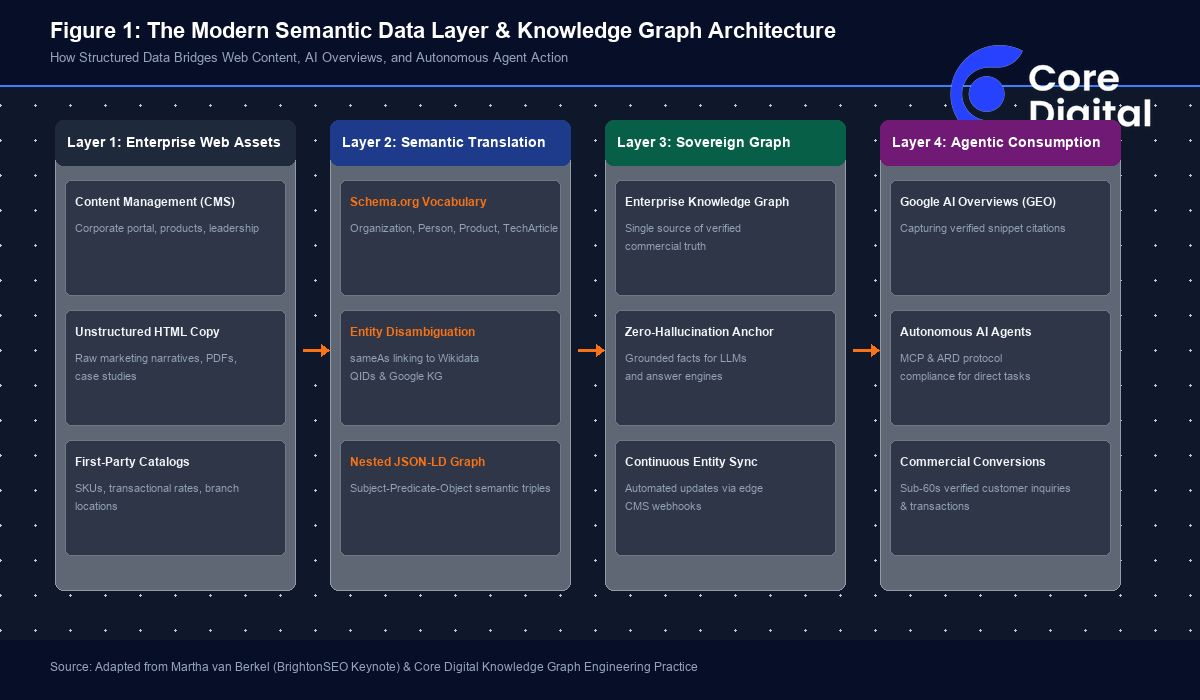
The most transformative concept presented by Martha van Berkel is that an enterprise website is no longer merely a visual brochure for human eyes. It is evolving into a semantic data layer for the entire digital marketing stack.
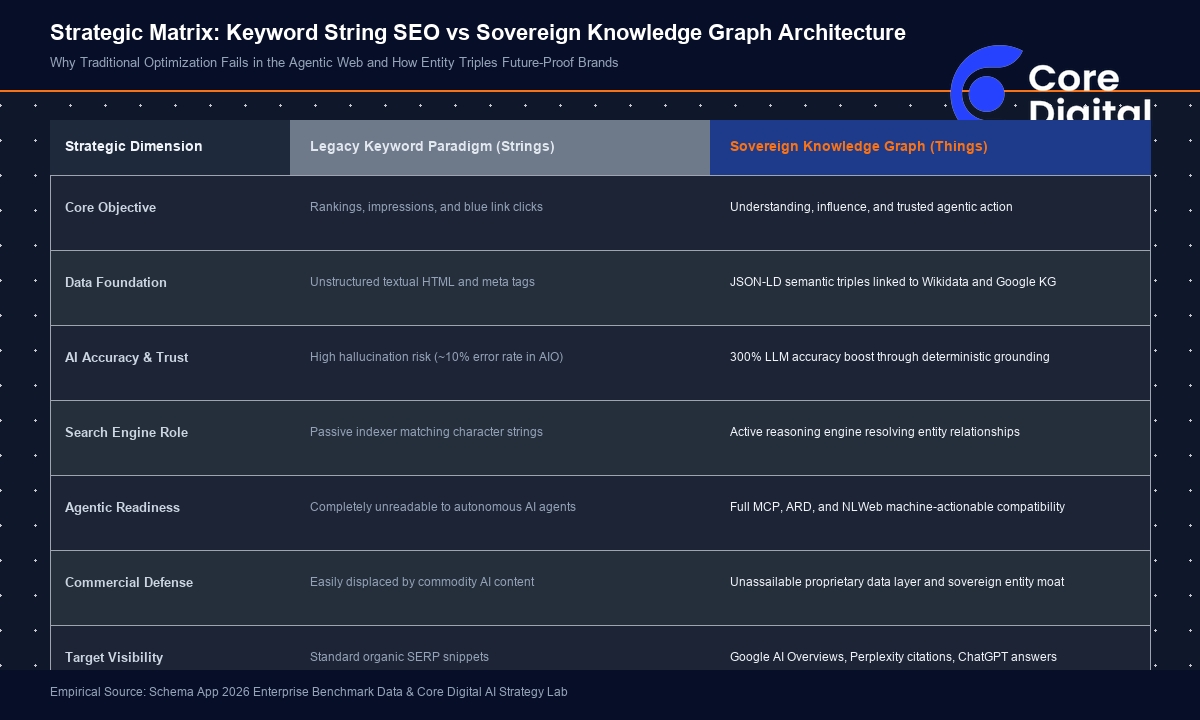
Historically, search engines operated as string matchers. If a user typed ‘commercial solar inverter Lagos’, Google scanned indexed HTML files for occurrences of those literal characters, evaluated backlink authority, and returned a list of blue hyperlinks.
Today, search engines operate as semantic knowledge engines. They do not match strings; they map entities. An entity is a singular, unique, well-defined concept or thing that exists in the physical or digital universe. A business is an entity. An executive is an entity. A proprietary software platform is an entity. A geographic service corridor is an entity.
When you structure your website using Schema.org vocabulary, you are translating human prose into formal semantic triples: Subject, Predicate, Object. For example:
[Core Digital] → (areaServed) → [Nigeria, Kenya, United Kingdom]
[Core Digital] → (founder) → [Paul Ejomafuvwe]
[Paul Ejomafuvwe] → (alumniOf) → [Business School Netherlands, Brand Management Academy]
By publishing these triples in clean JSON-LD script blocks, you eliminate inference. You supply Googlebot, Gemini, and Claude with mathematically grounded truth.
Entity Disambiguation: Why sameAs Triples Are Your Secret Weapon
One of the most practical masterclass takeaways from van Berkel’s presentation was the critical importance of entity disambiguation through authoritative URI linking.
Imagine you run an enterprise tech consultancy in Lagos named ‘Apex Solutions’. There are thousands of businesses globally named Apex Solutions. How does an AI engine know whether your platform is the logistics provider in Ikeja, the accounting firm in London, or the medical clinic in Atlanta?
Without disambiguation, the LLM combines features of all three entities, resulting in bizarre hallucinations about your services and pricing.
The solution lies in the sameAs property of Schema.org. By mapping your organizational entities, founders, and specialized disciplines to universally recognized knowledge bases like Wikidata and Google Knowledge Graph identifiers, you establish sovereign identity.
{
  "@context": "https://schema.org",
  "@type": "Organization",
  "@id": "https://coredigita.com/#organization",
  "name": "Core Digital",
  "url": "https://coredigita.com",
  "logo": "https://coredigita.com/wp-content/uploads/coredigital-logo-dark.png",
  "sameAs": [
    "https://www.linkedin.com/company/core-digital-hub",
    "https://twitter.com/coredigitahub"
  ],
  "knowsAbout": [
    {
      "@type": "Thing",
      "name": "Search Engine Optimization",
      "sameAs": "https://www.wikidata.org/wiki/Q180711"
    },
    {
      "@type": "Thing",
      "name": "Knowledge Graph",
      "sameAs": "https://www.wikidata.org/wiki/Q33002955"
    },
    {
      "@type": "Thing",
      "name": "Natural Language Processing",
      "sameAs": "https://www.wikidata.org/wiki/Q30642"
    }
  ]
}
Preparing for the Agentic Web: MCP, NLWeb, and ARD
Martha van Berkel closed her keynote by looking beyond search engines toward the imminent arrival of the Agentic Web. In this upcoming paradigm, software agents will not merely retrieve content; they will execute commercial transactions on behalf of users.
A procurement director will say to their corporate AI assistant: ‘Find the top three enterprise cloud migration partners in West Africa with ISO 27001 certification, compare their SLA terms, and book exploratory discovery calls with their technical leads.’
How will agents perform this task? They will rely on emerging open protocols:
- Model Context Protocol (MCP): An open standard allowing LLMs to securely query structured data layers and internal business databases.
- Microsoft NLWeb: Frameworks designed to turn web pages into conversational, queryable endpoints for natural language interactions.
- Agentic Resource Discovery (ARD): Machine-readable registries enabling autonomous agents to discover what actions an enterprise supports, including pricing queries, inventory reservations, and consultation scheduling.
If your enterprise website lacks a clean, validated knowledge graph, autonomous agents will simply bypass your business. You will be invisible to the very systems directing enterprise capital.
“In our brand management advisory across African markets, we frequently observe leadership teams treating Schema markup as an obscure technical chore delegated to junior web developers. This is a severe governance mistake. Your knowledge graph is your brand’s sovereign intellectual property in the AI age.”
“When you fail to explicitly define your organization’s entity relationships, products, and leadership credentials in machine-readable syntax, you surrender your corporate reputation to the probabilistic guesswork of foreign LLMs. Constructing a sovereign knowledge graph is not an IT cost; it is brand equity preservation and modern customer acquisition insurance.”
The 4-Step Action Plan for African Marketing Directors
To operationalize Martha van Berkel’s BrightonSEO frameworks immediately, commercial and technical teams should execute four concrete steps:
- Audit Your Entity Footprint: Use the Schema Validator and Google Rich Results Test to inspect your current structured data coverage. If your site only contains basic, auto-generated Yoast breadcrumbs, your machine-readable foundation is severely lacking.
- Construct Semantic Entity Triples: Map every core executive, product line, and geographical market to Wikidata QIDs. Define explicit relationships using
knowsAbout,hasOfferCatalog, andalumniOfproperties. - Ground Your High-Value Content: Attach dedicated
FAQPage,TechArticle, andReviewschema to all authoritative blog posts and case studies. This supplies the structured context required to capture Google AI Overviews and Perplexity citations. - Prepare for Agentic Discovery: Ensure your website architecture supports clean API endpoints, machine-readable pricing sheets, and direct contact schemas that allow autonomous agent systems to initiate inquiries seamlessly.
Frequently Asked Questions About Knowledge Graphs & AI Search
What is a Sovereign Knowledge Graph in SEO?
A sovereign knowledge graph is an enterprise-owned, standardized network of machine-readable facts (semantic triples) that formally defines a brand’s products, leadership, locations, and expertise using Schema.org vocabulary. It acts as the definitive single source of truth for search engines and AI agents, preventing hallucinations and ensuring brand accuracy.
How does Schema markup improve Google AI Overview citations?
Google AI Overviews rely on deterministic grounding to answer user queries safely. By structuring your content with nested Schema markup and entity links, you remove ambiguity, making it substantially easier for Google’s Gemini algorithms to extract, verify, and cite your content in generative summary boxes.
Why are Wikidata identifiers (QIDs) important in schema?
Wikidata is the largest open structured knowledge repository on the internet and a primary data source for Google’s Knowledge Graph and enterprise LLMs. Linking your schema properties to Wikidata QIDs using the sameAs attribute disambiguates your brand from similarly named entities worldwide.
Can small and mid-sized African businesses benefit from knowledge graphs?
Yes. In fact, mid-sized African enterprises benefit disproportionately because the competitive bar for structured data in emerging markets remains low. While competitors rely on generic blog posts, an enterprise with a clean knowledge graph can rapidly monopolize high-intent AI search results.
Ready to Engineer Your Enterprise Knowledge Graph?
Core Digital partners with ambitious African corporations, fintechs, and industrial leaders to build sovereign knowledge graphs, capture Google AI Overviews, and protect brand equity across the Agentic Web.