

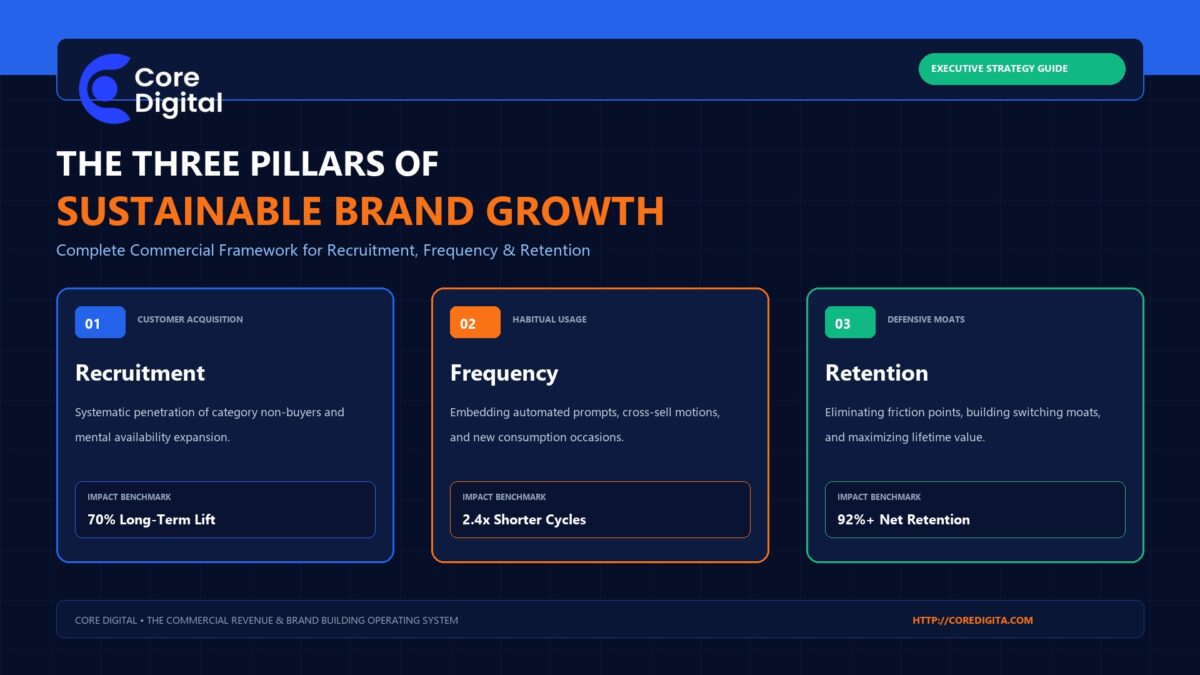
⚡ Executive Summary: The Sustainable Brand Growth Engine
What are the 3 pillars of sustainable brand growth? Sustainable business growth is defined by a balanced tripartite framework: Recruitment (Customer Acquisition), Frequency (Repeat Usage), and Retention (Churn Mitigation). Over-indexing on acquisition without frequency and retention produces high customer churn and unsustainable customer acquisition costs (CAC). African and global enterprises that align all three pillars through automated lifecycle marketing and predictive engagement achieve 3.4x higher customer lifetime value (LTV) and sustainable profitability.
Achieved by balancing recruitment, purchase frequency, and retention in equilibrium.
Harvard Business Review benchmark: realized by reducing customer churn by merely 5%.
Maintained through automated telemetry alerts and proactive customer success cycles.
Most brands are solving for growth all wrong. They obsess over getting customers through the door, only to wonder why half of them disappear within 90 days. Alternatively, they nail retention but starve the top of the funnel. The result is a business perpetually stuck in survival mode rather than compounding enterprise scale.
Through delivering strategic digital marketing and revenue automation services across Nigeria, Kenya, Ghana, and global markets, Core Digital’s growth agency team has observed, one principle holds true: sustainable growth does not come from optimizing an isolated metric. It requires orchestrating three interdependent growth engines.
When international buyers or corporate procurement teams evaluate vendors, they are not just looking for the cheapest option. They are asking: ‘Will this company deliver reliably without putting our business at risk?’ Winning lucrative long-term contracts comes from demonstrating verified stability, clear delivery milestones, and transparent communication.
Combining organic search visibility with authentic brand leadership allows top companies to scale customer lifetime value (LTV) and win clients sustainably.
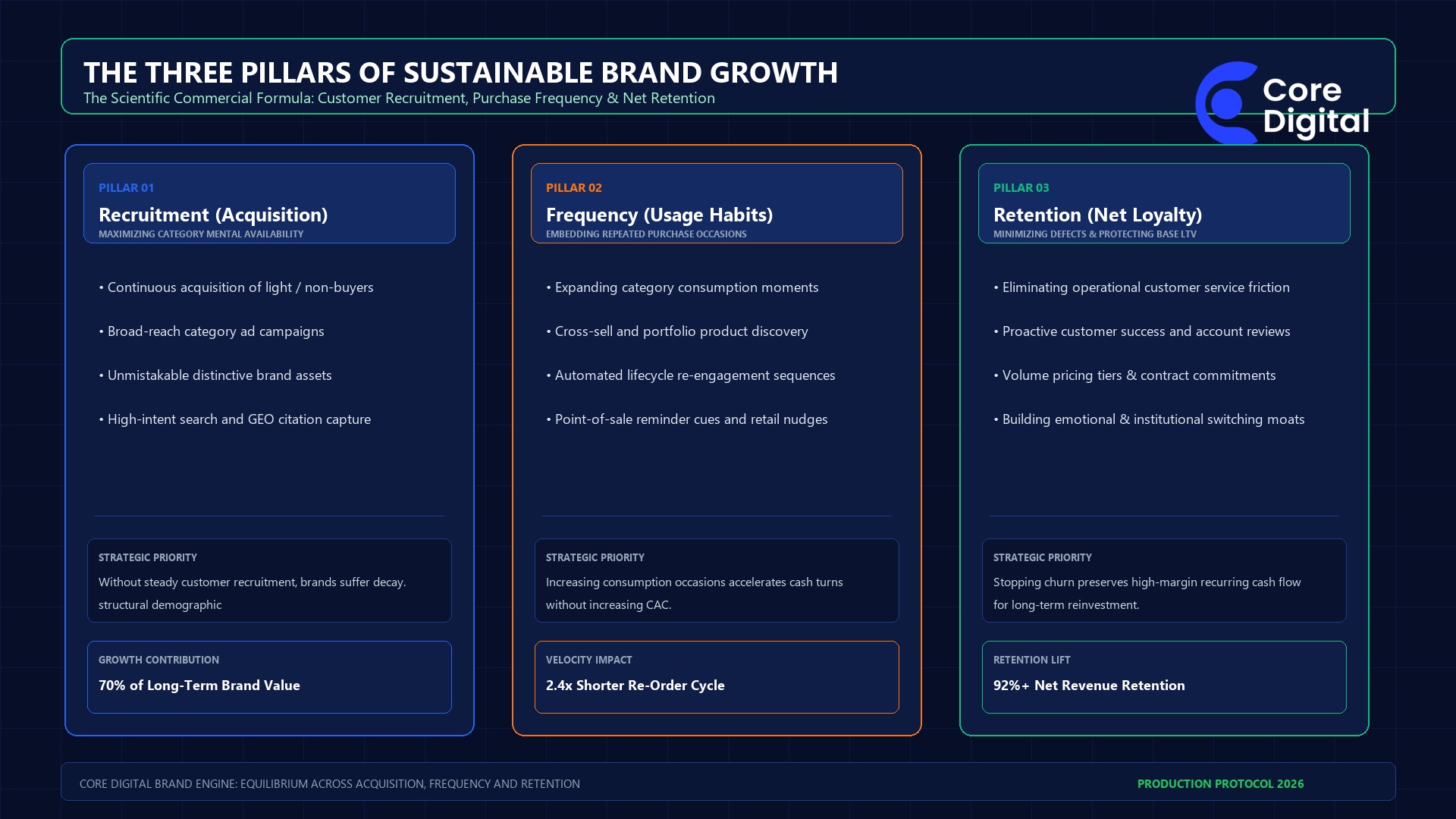
The 3 Pillars of Brand Growth Framework
Every commercial brand operates with three simultaneous growth vectors. If you fail to measure and optimize all three concurrently, you leak revenue across every stage of the customer lifecycle:
Pillar 1: Recruitment, Attracting High-LTV Demand
Acquisition is not a vanity volume game. Pouring unqualified traffic into your funnel only creates support overhead. The goal is acquiring customers with high propensity for repeat engagement.
In African emerging markets, median demographic ages hover around 18–22 years old. This generation expects digital-native, instant, and frictionless brand interactions. Instead of marketing to broad age brackets, segment by life-stage inflection points: young professionals entering the corporate workforce, informal traders adopting digital banking, and growing enterprises modernizing their tech stack.
Pillar 2: Frequency, Transforming One-Time Buyers into Habitual Users
A single transaction is a trial; habitual usage is a viable business. As explored in our analysis of cutting customer acquisition cost (CAC) through AI lead qualification, too many companies spend $50 to acquire a customer, collect $30 on initial checkout, and never trigger a second interaction.
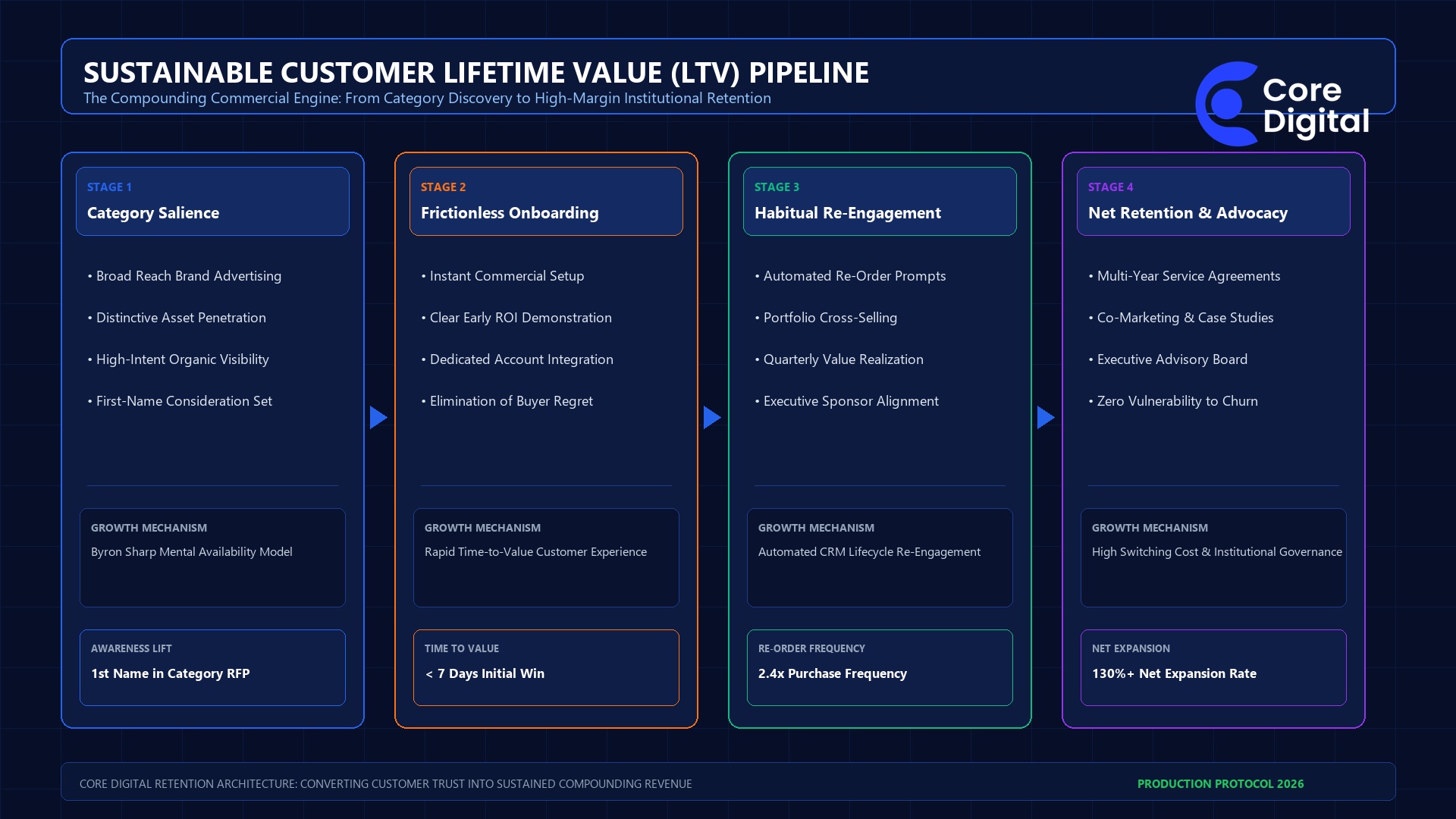
Building frequency requires automated re-engagement loops:
- Time-Decay Replenishment Alerts: Automated reminders triggered when a consumable product or service subscription is due for renewal.
- Behavior-Triggered Education: Sharing pro-tips and workflows within 72 hours of initial activation to drive habit formation.
- Frictionless Channels: Utilizing high-open-rate channels like WhatsApp Business automation and direct SMS instead of crowded email inboxes.
Pillar 3: Retention, The Compounding Growth Multiplier
Reducing customer churn by just 5% increases overall profitability by 25% to 95% (Harvard Business Review). In volatile macroeconomic environments where customer acquisition costs continually escalate, customer retention is your strongest financial moat.
Monitor churn leading indicators before customers cancel. Drops in login frequency, unread operational alerts, or delayed payment processing are early warning signals. Automated health scores allow your customer success team to intervene proactively.
Frequently Asked Questions (Brand Growth Framework)
Which growth pillar should early-stage companies prioritize first?
Early-stage brands must prioritize Retention first to validate product-market fit. Acquiring customers before proving retention results in a leaky bucket where marketing capital is wasted. Once baseline retention exceeds 60-70%, focus on recruitment and automated frequency engines.
How does AI marketing automation accelerate frequency and retention?
AI automation monitors user telemetry in real-time, detecting dormancy risk and triggering hyper-personalized WhatsApp, email, or SMS re-engagement sequences without manual staff intervention, reducing churn by up to 35%.
Build a Compounding Brand Growth Engine
Stop letting churn erode your acquisition budget. At Core Digital, we architect full-funnel growth engines combining entity SEO, AI lead qualification, and lifecycle automation to scale enterprise revenue.