
AEO & Technical SEO Extractable Node
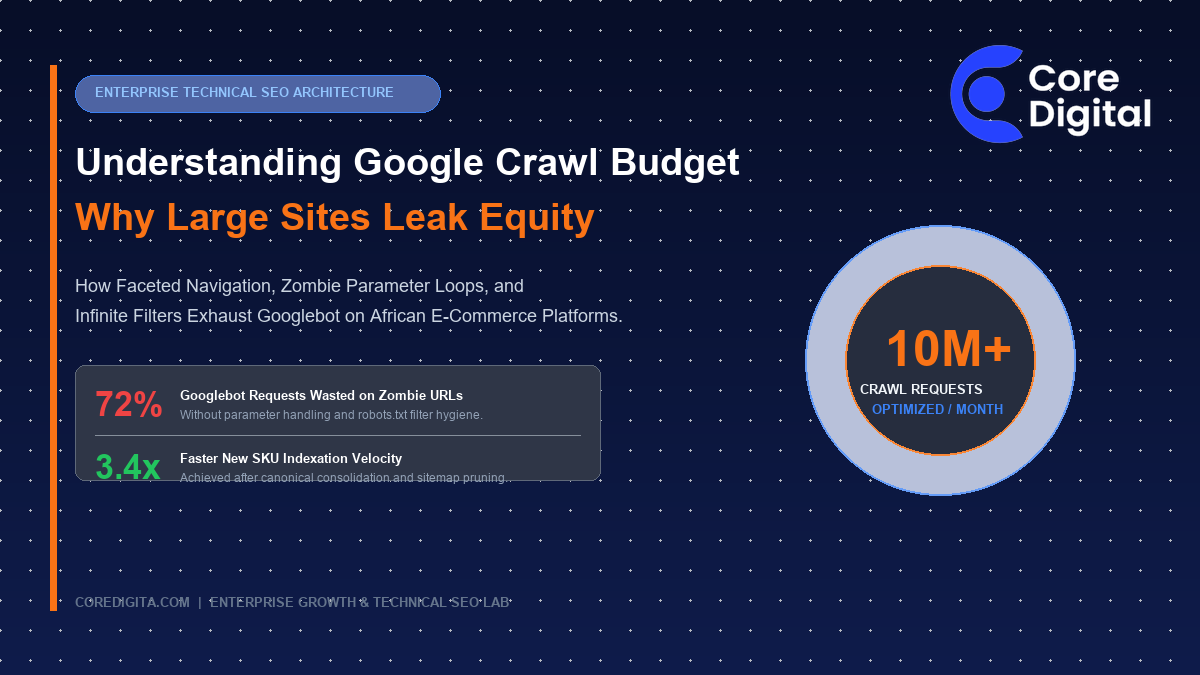
Google crawl budget represents the number of pages Googlebot is both willing and able to crawl on a domain within a given timeframe. When large Nigerian e-commerce retailers, multivendor marketplaces, and classified directories generate millions of uncanonicalized faceted filter URLs (such as sorting by price, color variations, and pagination chains), Googlebot exhausts its host load capacity on low-value duplicate pages. As a result, critical revenue-driving product pages take weeks or months to be indexed, leaking substantial commercial search equity.
For large e-commerce platforms operating across Lagos, Abuja, Port Harcourt, Nairobi, and Johannesburg, search engine optimization is rarely a game of publishing more blog articles. It is a game of server architecture, log file auditing, and strict crawl efficiency. When your product inventory spans tens of thousands of stock-keeping units (SKUs), how Googlebot navigates your taxonomy directly dictates your monthly organic revenue.
1. The Mechanics of Crawl Budget: Crawl Demand vs. Crawl Capacity
To diagnose why an e-commerce website experiences delayed indexation, engineering teams must dissect Google’s two-part crawl calculation:
- Crawl Capacity Limit (Host Load Limit): Googlebot is engineered not to crash your servers. If your web host or database responds with high Time-to-First-Byte (TTFB) or returns 503 Service Unavailable errors, Googlebot immediately scales back its concurrent connections. In emerging African markets where hosting infrastructure often faces connectivity latency, slow backend response times throttle crawl capacity instantly.
- Crawl Demand: This is Google’s appetite for re-crawling your URLs. It is driven by two factors: URL popularity (how many internal and external links point to a page) and page staleness (how frequently the content updates). High-demand pages like homepages and top categories are crawled daily, while deep product pages receive infrequent visits.
Crawl budget is simply the intersection of these two forces. When your engineering team builds an online store with 50,000 products, but filter parameters generate 1,500,000 distinct URLs, Googlebot’s finite crawl capacity gets squandered on low-value combinatorial variations.
2. Faceted Navigation Traps: How Color, Size, and Sorting Spawn Zombie URLs
Faceted navigation provides an intuitive shopping experience for humans. A user visiting a category page for “Men’s Sneakers” wants to filter by brand (Nike, Adidas), size (42, 43), color (Black, White), and price (Low to High).
However, without strict architectural discipline, the URL structure creates an exponential mathematical trap:
https://example-shop.com.ng/shoes/sneakers?color=black&brand=nike&sort=price_asc&size=42
https://example-shop.com.ng/shoes/sneakers?size=42&brand=nike&page=3
Notice that these three URLs return virtually identical content, but to a search engine bot, each represents a distinct endpoint that must be fetched, rendered, and evaluated. When thousands of products create millions of permutations, Googlebot enters an infinite crawl spiral. The spider spends 80% of its daily allocation downloading duplicate filter pages, while newly added inventory waits weeks for its initial crawl.
3. Log File Analysis: What Server Access Logs Reveal That Tools Cannot See
Third-party SEO audit tools simulate search bot behavior, but they cannot tell you what Googlebot actually did on your site yesterday. The only definitive record of search engine crawling is your raw server access log.
By conducting routine log file audits across your Nginx, Apache, or Cloudflare logs, enterprise development teams uncover:
- Crawl Waste Ratios: The exact percentage of total Googlebot hits hitting status code 200 URLs versus 301 redirects, 404 dead ends, or parameterized queries.
- Orphan Products: Products in your database that receive zero search bot visits over a 60-day period due to deep click paths.
- Host Load Throttling: Spikes in server response latency that directly correlate with drops in total crawl requests.
As detailed in our search console and Google analytics infrastructure services, integrating server-side log auditing with Google Search Console Crawl Stats is the foundation for enterprise search dominance.
4. Technical Remediation: 5 Rules to Eliminate Crawl Waste
Recovering lost crawl equity requires engineering changes at the server, header, and markup levels:
Enterprise Architectural Protocols:
- 1. Robots.txt Parameter Disallow Rules: Block non-commercial sorting parameters (e.g.
Disallow: /*?*sort=andDisallow: /*?*dir=) directly in robots.txt so Googlebot never wastes requests fetching them. - 2. Canonical Consolidation: Ensure every filtered variation points a clean rel=”canonical” tag to the primary indexable category or master product URL.
- 3. AJAX / Client-Side Filter State: Keep filters dynamic using HTML5 pushState without generating new crawlable anchor tags for low-volume attributes.
- 4. Prune XML Sitemaps: Never include noindex pages, redirects, or non-canonical parameters in your XML sitemaps. Your sitemaps must only contain 100% clean, 200 OK commercial canonical URLs.
- 5. Deploy Machine-Readable Root Standards: Implement llms.txt and pricing.md files to allow modern AI search engines to parse your core commercial catalog without crawl friction.
“When large African e-commerce platforms struggle with organic growth, founders frequently blame content or backlink deficiencies. In our audits, eight times out of ten the real culprit is crawl budget exhaustion. Millions of Naira in server hosting are spent serving 404s and faceted loops to bots while the top-selling inventory remains unindexed.”
“Fixing your crawl budget instantly unlocks existing content equity. When you guide Googlebot directly to your revenue assets, indexation velocity improves overnight, and organic transactions compound.”
Frequently Asked Questions About Google Crawl Budget
How do you know if your website has a crawl budget problem?
Open the Google Search Console “Crawl Stats” report. If newly published products take weeks to appear in Google search while your daily crawl requests exceed hundreds of thousands of hits, your crawl equity is leaking into duplicate parameters or redirect loops.
How does canonicalization preserve search equity?
Canonical tags instruct search engines on which version of a URL represents the primary master asset. This consolidates duplicate filter variants and pagination links into a single authoritative ranking asset, concentrating link equity and ranking signals.
Does site speed affect crawl budget?
Yes, directly. If your web server responds quickly (under 200ms TTFB), Googlebot can download more pages per connection without overloading your infrastructure. When server response times slow down, Googlebot automatically reduces its crawl rate to protect user experience.
Ready to Eliminate Crawl Waste & Scale Your Organic Revenue?
Partner with Core Digital to conduct full server log audits, eliminate faceted crawl loops, engineer sub-second mobile performance, and capture dominant search market share across Nigeria and Africa.