

August 2026 Masterclass Synthesis
The Acceleration Paradox: Velocity vs. Control in Modern African Campaigns
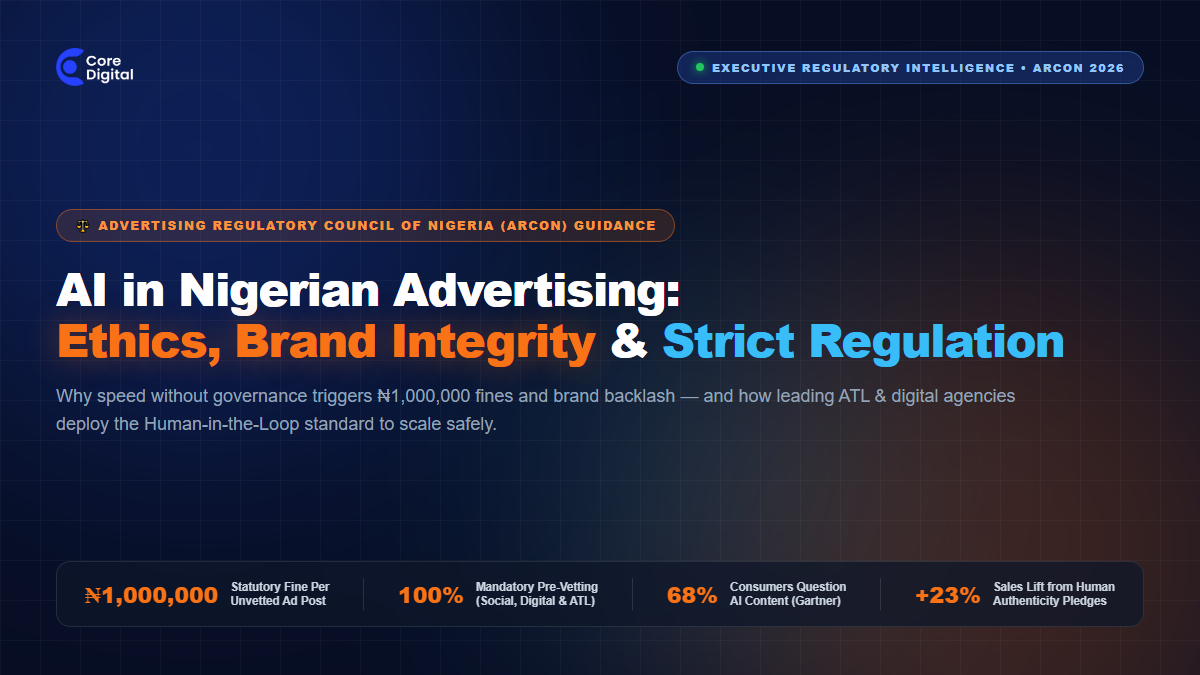
Generative artificial intelligence has compressed commercial campaign production cycles from twelve months to under thirty days. But as advertising agencies and brands race to deploy synthetic copy, digital avatars, and programmatic imagery, regulatory authorities have drawn an immutable line in the sand.
On Wednesday, August 12, 2026, at the L’EOLA Hotel in Maryland, Lagos, commercial advertising executives, corporate brand directors, and compliance specialists gathered for the Advertising Regulatory Council of Nigeria (ARCON) Artificial Intelligence in Advertising Training Course.
Delivering the keynote paper on “Ethics, Brand Integrity, Transparency and Regulation,” Akin Adesola, Founder and Strategy Director of The Mellow Dukes Project Foundry, articulated the central thesis confronting the marketing communications industry:
“The question for this room isn’t whether to use AI — it’s how to innovate at algorithm speed while protecting consumers at the speed of human judgment and law.”
In this comprehensive guide, Core Digital deconstructs the legal jurisprudence governing AI advertising in Nigeria, analyzes the critical enforcement actions shaping our market, examines why global campaigns backfired when replacing human connection with synthetic algorithms, and presents the definitive Human-in-the-Loop (HITL) Framework for high-growth brands.
1. ARCON’s Statutory Footing: The April 2025 Federal High Court Ruling
For years, many digital marketing practitioners, skit makers, and social media influencers operated under the erroneous belief that advertising regulations applied exclusively to traditional “Above-The-Line” (ATL) channels—such as national television, terrestrial radio, and physical highway billboards.
That illusion was permanently dismantled in April 2025, when the Federal High Court of Nigeria delivered a landmark ruling formally upholding the regulatory supremacy of the Advertising Regulatory Council of Nigeria Act No. 23 of 2022.
Key Legal Takeaways from the Federal High Court Judgment:
- Universal Scope of Jurisdiction: ARCON’s regulatory oversight applies to every advertiser targeting consumers within Nigeria, not merely registered advertising agencies or traditional media houses.
- Digital & Social Media Equality: 100% of commercial advertisements—whether an electronic billboard on the Lekki-Epe expressway or a single sponsored post on Instagram, TikTok, Facebook, X, or YouTube—fall under the statutory mandate: truthful, legal, decent, honest, and socially responsible.
- Mandatory Pre-Exposure Vetting (Section 53): No commercial marketing communication can be exposed to the Nigerian public without prior review and formal certificate of approval issued by the Advertising Standards Panel (ASP).
- ₦1,000,000 Fine Per Violation: Disseminating an unapproved or unvetted ad on digital platforms carries a statutory fine of up to ₦1,000,000 per violation, alongside potential platform-level takedowns and professional sanctions.
Crucially, ARCON’s regulatory posture is technology-agnostic. The council regulates the message, truthfulness, and societal impact of an advertisement, not the software tool that created it. If an AI copywriter hallucinates an unsubstantiated medical claim, or an AI image generator renders a misleading financial guarantee, the law holds the advertiser and the marketing agency strictly liable. OpenAI, Midjourney, or Anthropic will not bear legal responsibility in a Nigerian court—the brand on the invoice does.
2. The Frontline of Synthetic Fraud: High-Profile Nigerian Deepfake Cases
The urgency behind ARCON’s enforcement is driven by real-world abuses. Over the past 18 months, bad actors have exploited synthetic media tools to defraud citizens, impersonate national leadership, and erode societal trust.
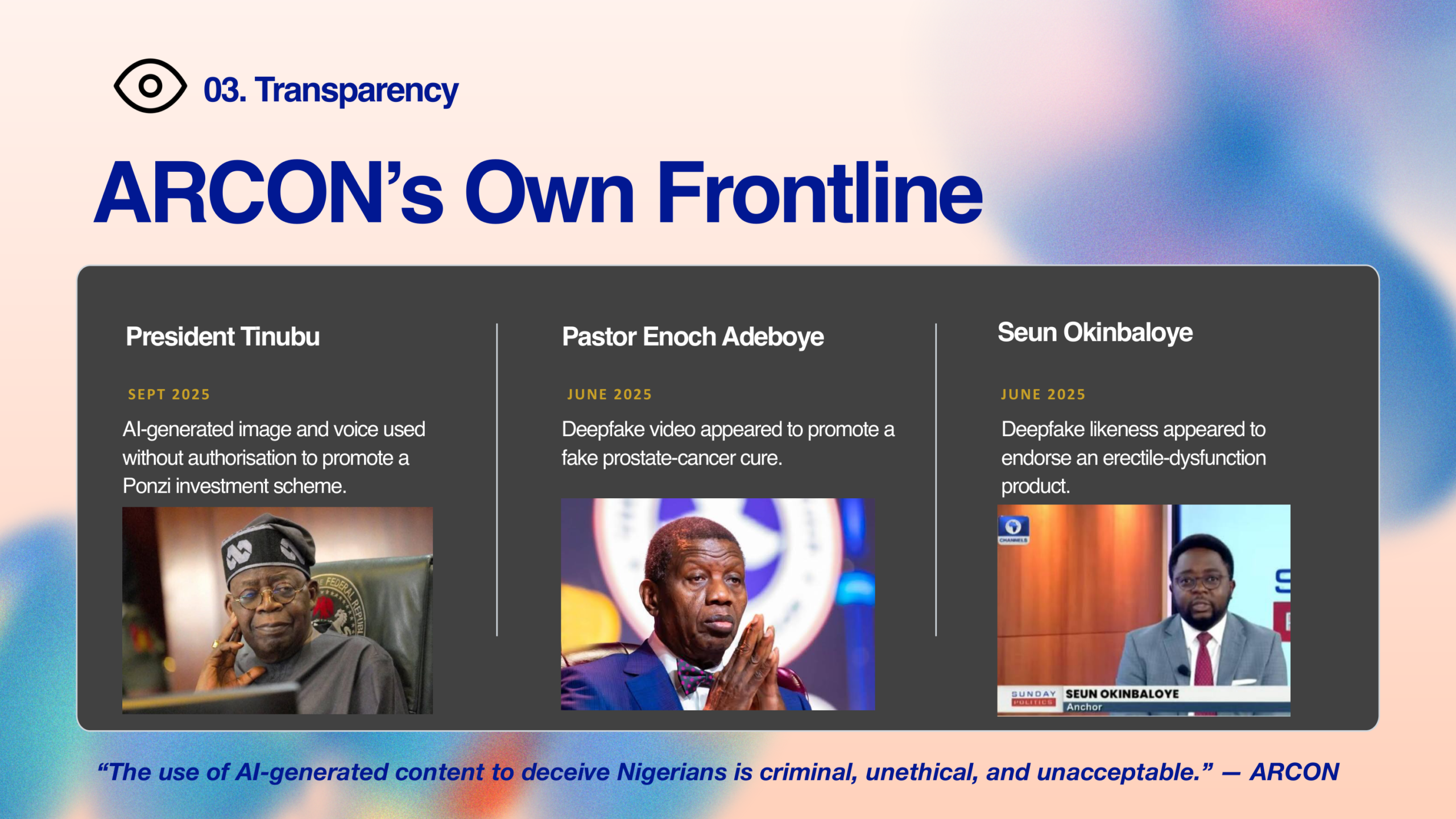
President Bola Ahmed Tinubu
A synthetic AI-generated video with voice cloning fabricated the Nigerian President endorsing an unverified Ponzi investment scheme, designed to fleece retail investors. ARCON issued immediate cease-and-desist orders and activated inter-agency cybercrime enforcement.
Pastor Enoch Adeboye
Scammers generated a deepfake video showing the General Overseer of the Redeemed Christian Church of God (RCCG) purportedly advertising a “miracle” herbal prostate cancer cure. ARCON sanctioned the campaign for severe violation of drug advertising protocols.
Seun Okinbaloye (Channels TV)
Bad actors deepfaked the set of Channels TV’s Politics Today and host Seun Okinbaloye to simulate a breaking news bulletin promoting an erectile dysfunction remedy. ARCON took immediate action to protect journalistic credibility and public health.
ARCON’s public warning on these cases was unequivocal: “The use of AI-generated content to deceive Nigerians is criminal, unethical, and unacceptable.”
3. When AI Backfires: Strategic Lessons from McDonald’s and Coca-Cola
While criminal fraud represents the extreme fringe, legitimate global corporate brands have stumbled heavily when using generative AI without human empathy and brand humility.
Case Study A: McDonald’s Philippines vs. Burger King (“Craving Realness”)
In late 2025, McDonald’s Philippines launched an AI-generated brand video attempting to deliver a philosophical message: “AI can study data, but it cannot replace human emotional connection and sensory experience.”
Audiences and industry observers immediately condemned the irony: McDonald’s had utilized an artificial, synthetic generation pipeline to lecture consumers about the sanctity of real human connection.
Competitor Burger King Philippines struck back with devastating speed. They published an image of their golden french fries with the letter “A” in “AI” struck through to read: “I want to taste realness,” accompanied by the viral caption: “Why listen to AI when you’re craving realness?” McDonald’s spent marketing millions only to hand their chief competitor a massive PR victory.
Case Study B: Coca-Cola’s AI Holiday Caravan and the “Uncanny Valley”
Seeking radical cost reductions and speed, Coca-Cola partnered with generative AI studios (Silverside AI and Secret Level) to recreate its beloved 1995 “Holidays Are Coming” Christmas commercial entirely via synthetic generative pipelines. They succeeded in compressing production from a full year to just one month.
The commercial was met with global backlash. Audiences described the synthetic characters as eerie and cold, noting unnatural facial expressions, plastic skin textures, and physically impossible movement dynamics—the classic psychological “uncanny valley”. In its quest for algorithmic velocity, Coca-Cola sacrificed the very emotional warmth and human nostalgia that built its multi-billion-dollar holiday equity.
4. The Trust Math: Why Human Authenticity Commands a 23% Commercial Lift
The commercial risk of uncurated AI is no longer a matter of artistic preference; it is empirical financial mathematics.
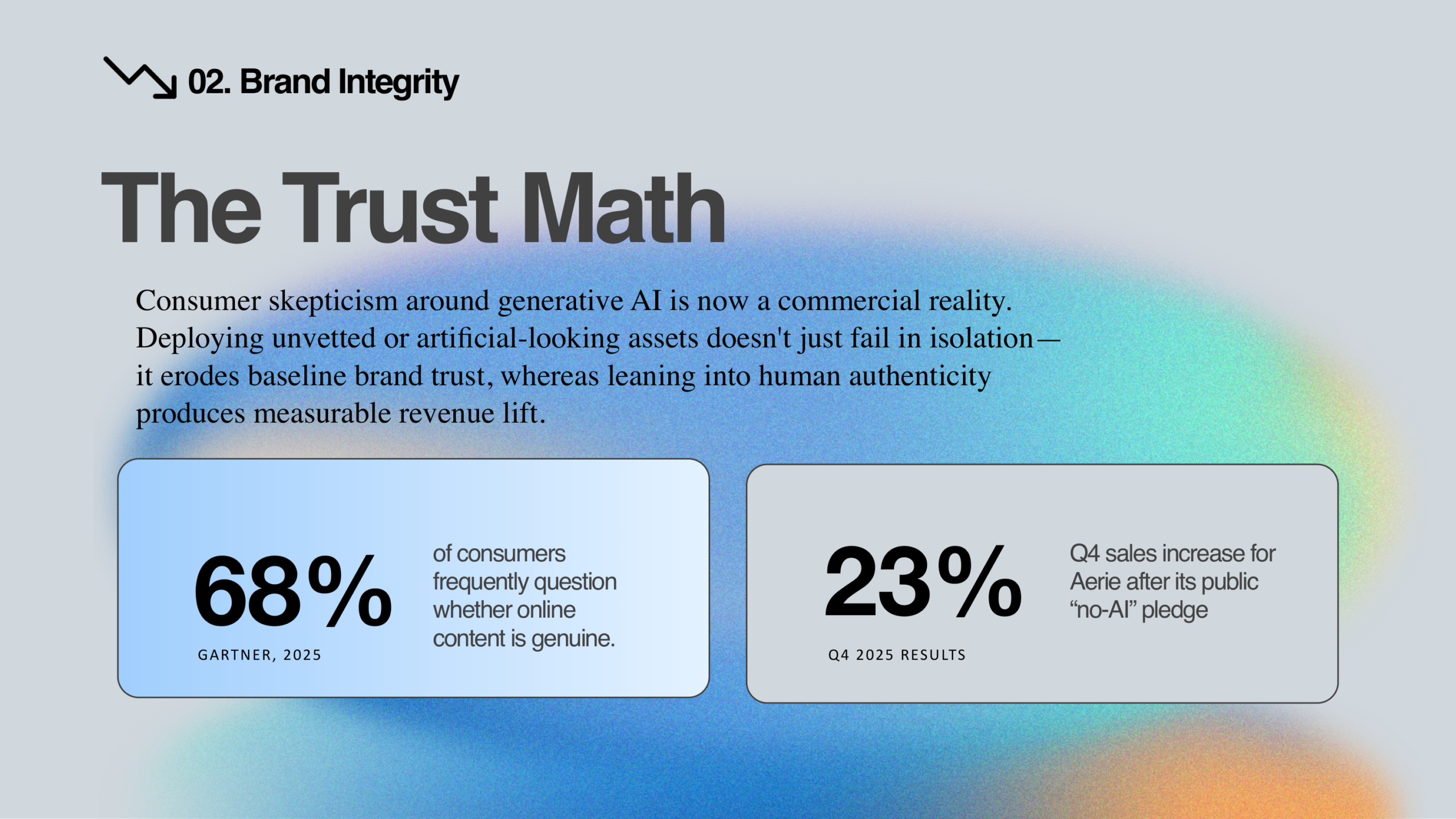
According to benchmark research from Gartner (2025), 68% of consumers frequently question whether online commercial content is genuine. When brands publish generic, synthetic assets, consumer skepticism surges, and ad fatigue compounds.
Conversely, brands that explicitly lean into human authenticity generate superior commercial returns. When apparel and lifestyle brand Aerie instituted a formal, public “No-AI” creative pledge—guaranteeing 100% real human models, unretouched photography, and zero generative avatars—the company recorded a 23% sales increase in Q4. Real human connection is no longer an agency luxury; it is a high-margin differentiator.
5. The ARCON AI Advertising Governance Matrix
To protect brand equity while harnessing AI speed, Nigerian commercial organizations must systematically confront four operational pillars before exposing any campaign asset to the market:
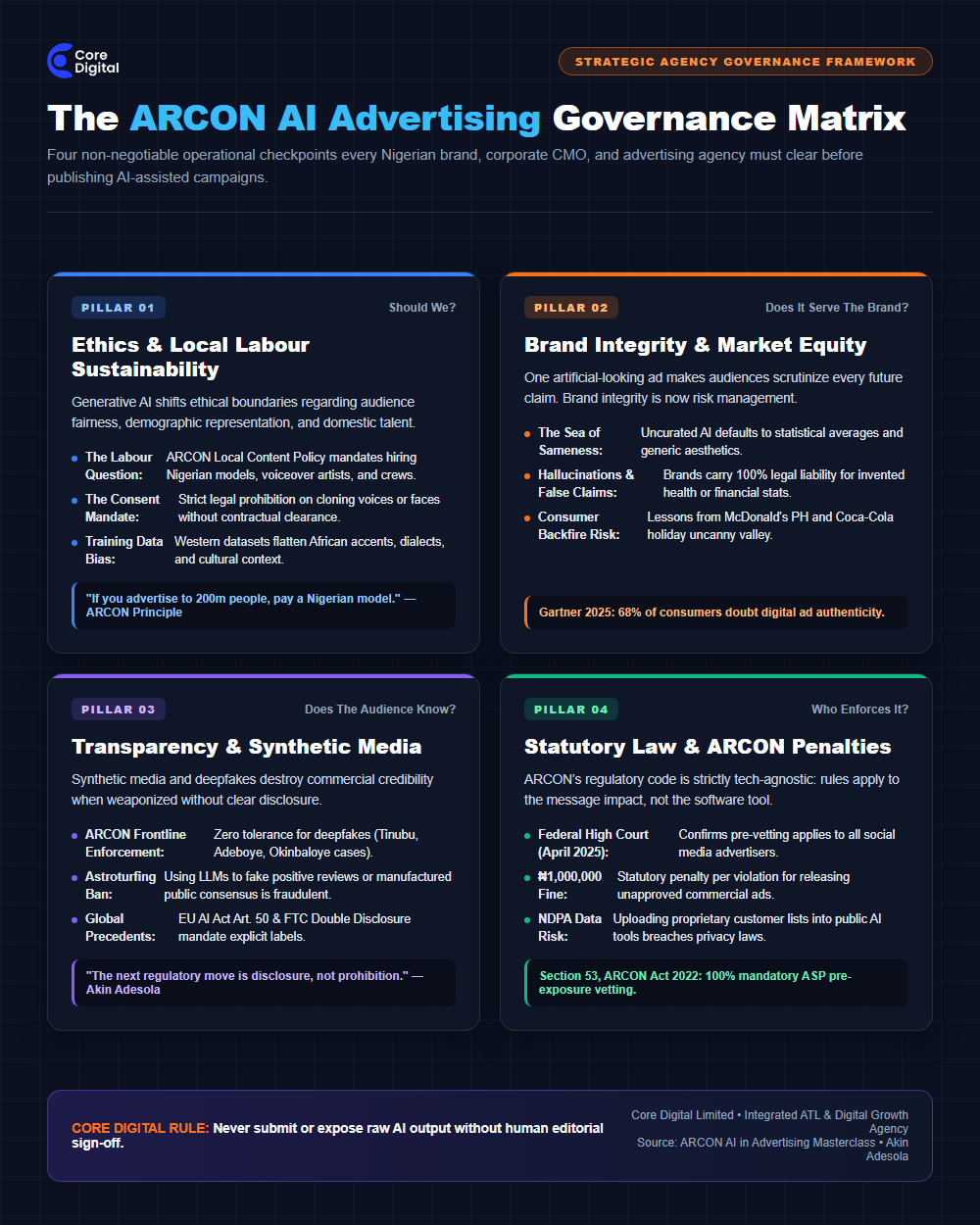
Deep-Dive into the 4 Pillars:
Pillar 01: Ethics (Should We?)
Enforces ARCON’s National Local Content Policy. Generative AI must not be used as a loophole to displace Nigerian voiceover artists, models, actors, and post-production crews. ARCON’s governing philosophy remains clear: “If you are advertising to over 200 million Nigerians, you should be able to find one of us worthy of conveying your message — and you should pay that model.” Furthermore, voice and facial cloning require explicit, written contractual consent prior to generation.
Pillar 02: Brand Integrity (Does It Serve the Brand?)
Eliminates the “Sea of Sameness.” Raw AI models default to the statistical average of foreign training data, producing identical, generic stock imagery. Brand integrity demands that human strategists inject cultural texture, authentic Nigerian humor, and category-defining visual distinctiveness.
Pillar 03: Transparency (Does the Audience Know?)
Prohibits algorithmic astroturfing and synthetic consensus. Deploying LLMs to generate fake app store reviews, fabricate e-commerce testimonials, or flood social media comment sections with synthetic bots constitutes fraudulent deception under Nigerian consumer protection law.
Pillar 04: Regulation (Who Enforces It?)
Strict adherence to Section 53 ASP pre-vetting and the Nigeria Data Protection Act (NDPA). Feeding confidential customer CRM lists into public, multi-tenant AI tools violates data sovereignty and privacy mandates, exposing corporations to regulatory prosecution.
6. Global Disclosure Benchmarks: What Nigeria Will Adopt Next
As Akin Adesola noted in his keynote address: “The next regulatory move is disclosure, not prohibition. Build the habit before it’s mandatory.”
Nigeria’s regulatory trajectory is mirroring major international jurisprudence. Forward-thinking Nigerian CMOs are already aligning internal workflows with these established global frameworks:
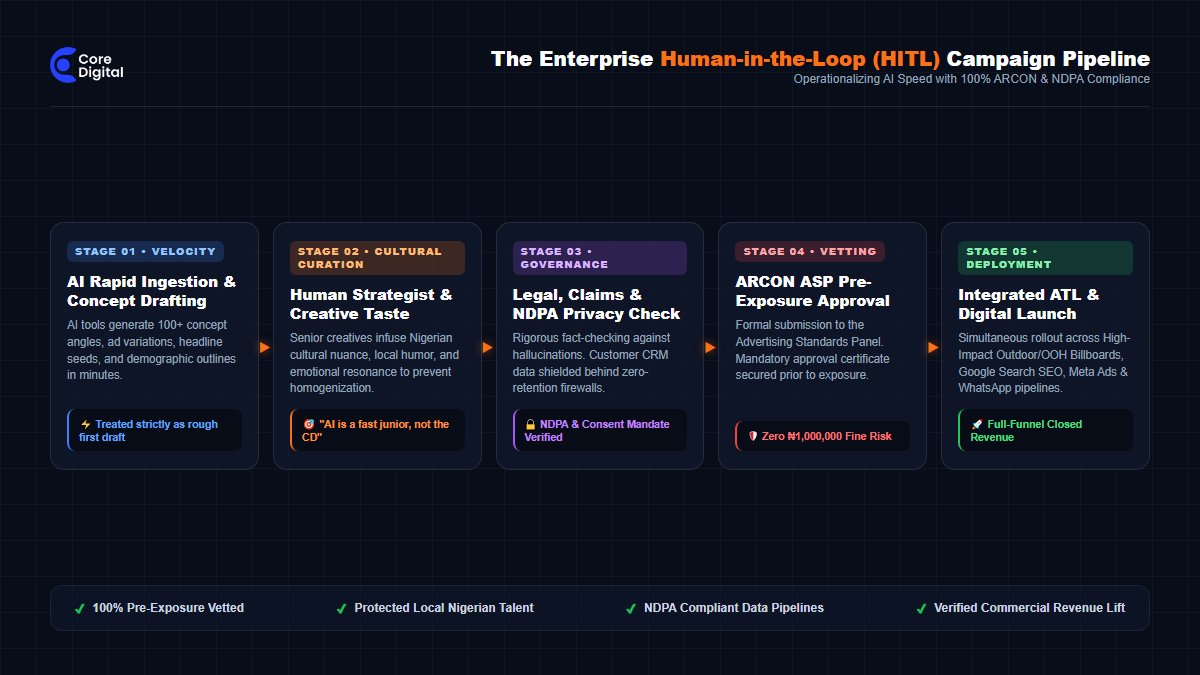
7. The Enterprise Human-in-the-Loop (HITL) Campaign Pipeline
How do forward-thinking marketing agencies achieve 10x production speed without risking regulatory penalties or brand dilution? The answer is operationalizing the Human-in-the-Loop (HITL) Workflow.
As Esosa Osagiede, Group Creative Director at Insight Publicis, famously encapsulated: “AI is a very fast junior. It is not your creative director.” AI produces high-volume concept variations; human judgment curates taste, cultural context, and legal compliance.
8. The Monday Morning Agency Compliance Checklist
To protect your organization starting immediately, place this 6-point operational checklist on the desks of your creative directors, copywriters, and media planners:
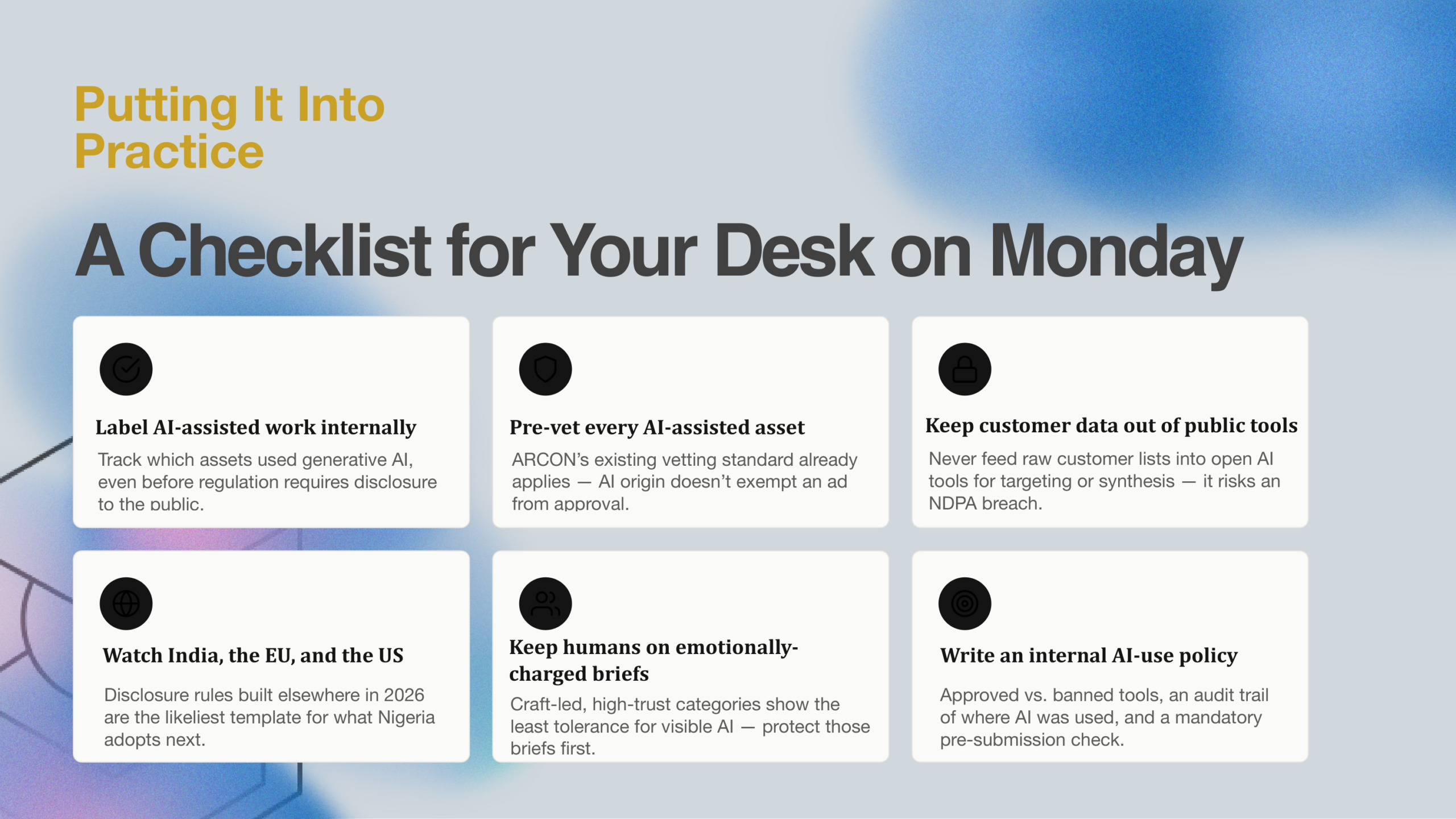
- Label AI-Assisted Work Internally: Establish an internal registry documenting which visual, copy, or audio components used generative AI, creating a verifiable audit trail before client presentation.
- Pre-Vet Every AI-Assisted Asset: Ensure all digital ads, influencer assets, and ATL media are formally submitted to the ARCON Advertising Standards Panel (ASP). AI origin offers zero regulatory exemption.
- Keep Customer Data Out of Public AI Tools: Never upload proprietary customer databases, CRM spreadsheets, or audience lists into public LLMs. Doing so constitutes an immediate breach of the Nigeria Data Protection Act (NDPA).
- Monitor India, the EU, and the US: Track regulatory templates from ASCI, the FTC, and the EU AI Act to anticipate ARCON’s forthcoming mandatory disclosure codification.
- Keep Humans on Emotionally Charged Briefs: High-trust, culturally sensitive categories (financial services, healthcare, national celebrations) exhibit zero tolerance for synthetic coldness. Protect human casting on high-stakes briefs.
- Draft an Internal Corporate AI Policy: Codify approved vs. banned software tools, require mandatory human sign-off, and establish clear legal indemnification protocols with enterprise clients.
9. Core Digital: Where ATL Stature Meets Digital Performance Precision
As the Nigerian advertising landscape matures, the artificial divide between “traditional ATL agencies” and “digital boutique shops” is obsolete. High-growth enterprises require both the unshakeable credibility of Above-The-Line brand stature and the high-velocity conversion power of digital performance systems.
At Core Digital Limited, we bridge this full-funnel spectrum with zero compromise on regulatory compliance:
Mass Stature & Brand Permanence
High-impact Out-of-Home (OOH) billboards, dynamic LED digital outdoor hoardings, airport advertising, and mass broadcast creative that build undisputed brand authority and household trust across African markets.
Precision Conversion & Speed-to-Lead
Dominating Google Page 1 search rankings (SEO & AI Search GEO), targeted performance advertising across Meta and LinkedIn, and automated WhatsApp sales pipelines delivering under-60-second responses to capture every dollar of offline awareness.
Trusted by premier Nigerian institutions and commercial giants—including Tolaram Group, Matrix Energy, Superflux International, QShelter, Munch It, and Petroleum Training Institute (PTI)—we ensure that whether your message commands a 100-foot billboard in Lagos or an AI-targeted mobile search ad in Abuja, your brand maintains unassailable regulatory integrity and proven revenue velocity.
Enterprise Growth & Governance
Ready to Scale Your Brand with Zero Regulatory Risk?
Download the official Core Digital Company Profile & Capability Guide, or connect directly with our senior growth partners to audit your marketing pipelines and secure full ARCON compliance.