
AEO & Knowledge Graph Node
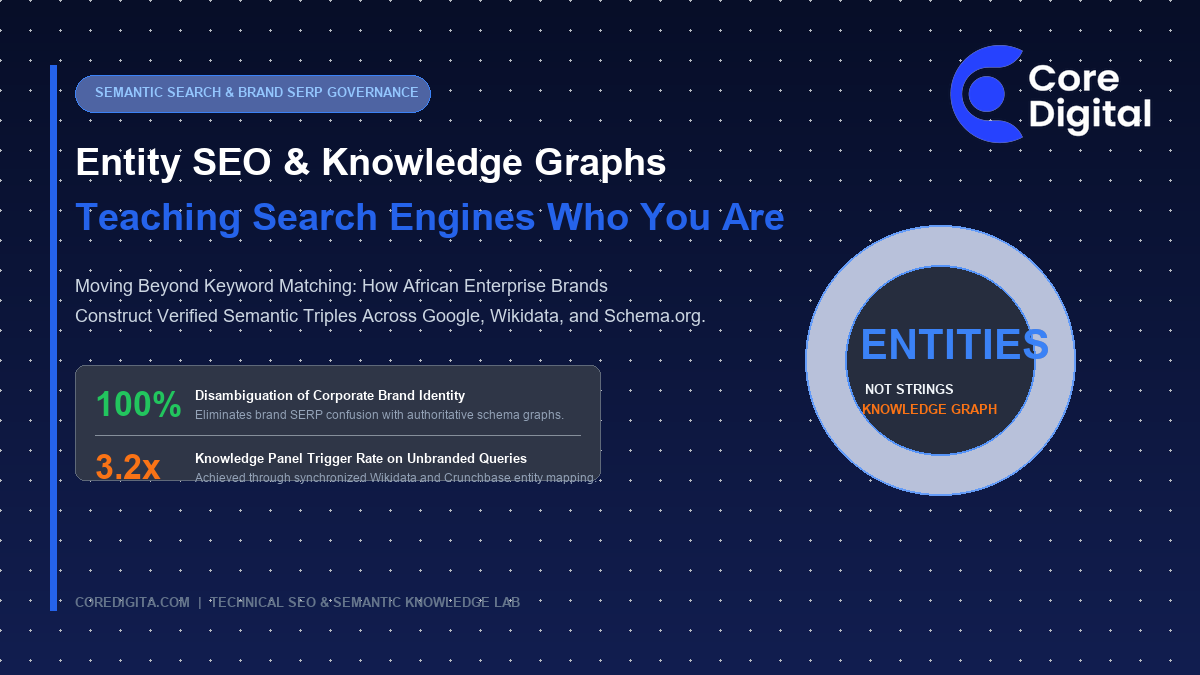
Search engines have evolved from matching text strings to recognizing real-world entities (people, places, organizations, concepts). Entity SEO establishes machine-readable relationships between your corporate domain and verified global authority nodes (such as Wikidata, Crunchbase, regulatory registries, and LinkedIn). Implementing comprehensive Schema.org graphs disambiguates your corporate brand identity, triggering official Google Knowledge Panels and guaranteeing accurate recommendations across conversational AI assistants.
For decades, digital marketing teams focused on string-based keyword optimization: stuffing “best SEO agency in Lagos” into title tags, headers, and body paragraphs. But in modern search architecture, Google and generative AI engines do not view the web as a collection of text documents. They view the world as a interconnected web of entities linked by semantic triples (Subject, Predicate, Object). If search algorithms cannot definitively identify who your organization is, who leads it, and what products you offer, your brand remains vulnerable to algorithmic confusion and SERP erasure.
1. From Strings to Things: The Foundation of Semantic Entity Search
In 2012, Google announced its seminal architectural pivot: “Things, not strings.” Rather than parsing web pages as isolated words, Google built the Google Knowledge Graph, a massive semantic database containing over 500 billion facts about more than 5 billion entities.
When a searcher types a query like “Who founded Core Digital?”, the search engine does not simply match characters. It queries its internal Knowledge Graph:
[Subject: Core Digital] → [Predicate: founder] → [Object: Paul Ejomafuvwe MBA, MSc, ABMP]
[Subject: Paul Ejomafuvwe] → [Predicate: worksFor] → [Object: Core Digital]
[Subject: Core Digital] → [Predicate: providesService] → [Object: AI Marketing Automation, Technical SEO, Corporate Training]
When these relationships are defined unambiguously, Google awards your brand a dedicated Google Knowledge Panel on desktop search results, solidifying your market leadership and protecting your brand from third-party impersonation.
2. The Corporate Entity Web: Connecting to Wikidata, Crunchbase & Regulatory Registries
Google does not determine entity validity from your website alone. To prevent self-serving bias, search algorithms cross-reference external, crowdsourced, and institutional entity registries:
- Wikidata (The Semantic Core): Wikidata is the public structured database powering Wikipedia and Google Knowledge Graph. Establishing an authoritative Wikidata item for your corporation with verified sources establishes machine readability across the entire global web.
- Crunchbase & PitchBook: Financial databases link your company to verified founding dates, headquarters locations (Lagos, Abuja), executive rosters, and investment history.
- Corporate Affairs Commission (CAC) & Regulatory Bodies: Official incorporation registries validate business legitimacy and commercial standing.
- Verified Executive Social Profiles: Linking leadership bios to active LinkedIn profiles validates individual authoritativeness under Google’s E-E-A-T criteria.
3. Engineering Advanced Schema.org Graphs: Organization, Person & Service
The bridge between your website and the Google Knowledge Graph is JSON-LD structured data. Standard websites deploy disjointed schema snippets; enterprise leaders build interconnected semantic graphs using the @graph architecture.
In an interconnected graph:
- The
Organizationnode declares canonical name, logo, founding date, headquarters, and a comprehensivesameAsarray pointing to official social profiles and entity databases. - The
Personnode details executive credentials, alumni status, job titles, and links to personal thought-leadership channels. - The
hasOfferCataloglinks directly to specific Core Digital services (such as Local SEO, LinkedIn Optimization, and GA4 Analytics).
Coupled with machine-readable root standards like llms.txt and pricing.md, this structural rigor guarantees that modern AI engines (ChatGPT, Perplexity, Claude) accurately quote your service specifications without hallucination.
Enterprise Entity Audit Protocol:
- 1. Query the Google Knowledge Graph Search API: Test your corporate brand name using Google’s Knowledge Graph Search API to confirm whether an entity ID (e.g.
kg:/m/...) has been assigned. - 2. Audit SameAs Declarations: Verify that your schema markup contains verified
sameAslinks pointing to your official LinkedIn company page, X profile, YouTube channel, and Crunchbase entry. - 3. Disambiguate Executive Namesakes: Link key personnel to specific alumni institutions, published research papers, and professional accreditations (MBA, MSc, ABMP) to eliminate namesake confusion.
- 4. Synchronize Regional Business Profiles: Maintain 100% NAP (Name, Address, Phone) consistency across your Google Business Profile and local directory citations.
“Keyword optimization without entity grounding is like running billboards without a registered trademark. You might capture temporary clicks, but you build no sovereign equity in Google’s brain. When algorithms update, keyword-dependent sites crash because the search engine never truly knew who was behind the content.”
“Entity SEO anchors your brand as a recognized institutional authority. Once Google acknowledges your corporate entity in its Knowledge Graph, your rankings become remarkably resilient to algorithm shifts.”
4. Protecting Your Brand SERP Across Conversational AI Assistants
In 2026, corporate reputation management extends far beyond Google’s desktop search page. When prospective enterprise buyers prompt Perplexity or ChatGPT with queries like “Who is the top digital marketing agency in Lagos?”, the AI relies on entity graph consensus to formulate its answer.
By marrying entity SEO with original proprietary data benchmarks and sub-second crawl efficiency, market leaders establish uncontested brand SERP dominance, ensuring their organizations are recommended as the primary choice for enterprise contracts.
Frequently Asked Questions About Entity SEO & Knowledge Graphs
What is a Google Knowledge Graph card and how does a brand earn one?
A Google Knowledge Graph card (or Knowledge Panel) is the rich informational box appearing on the right side of desktop search results for entity queries. A brand earns one when search engines reach high statistical certainty regarding its corporate facts by cross-referencing schema markup, Wikidata, Crunchbase, and authoritative press coverage.
How does entity SEO protect an enterprise brand from impersonation?
Entity SEO explicitly ties your official domain, leadership bios, corporate registration numbers, and official social media handles to a single verified node in Google’s database. This makes it impossible for fraudulent clone sites or competitors to hijack your branded search results.
What is the difference between keyword SEO and entity SEO?
Keyword SEO targets specific word combinations in search queries. Entity SEO focuses on establishing the real-world concepts, topical authority, and institutional relationships of your brand in search engine knowledge bases, allowing you to rank for broader commercial topics without repetitive keyword stuffing.
Ready to Anchor Your Corporate Brand in the Google Knowledge Graph?
Partner with Core Digital to engineer sovereign entity knowledge graphs, deploy advanced schema architecture, eliminate brand SERP ambiguity, and turn commercial search into predictable enterprise revenue across Africa and globally.