

AEO & Data Moat Node
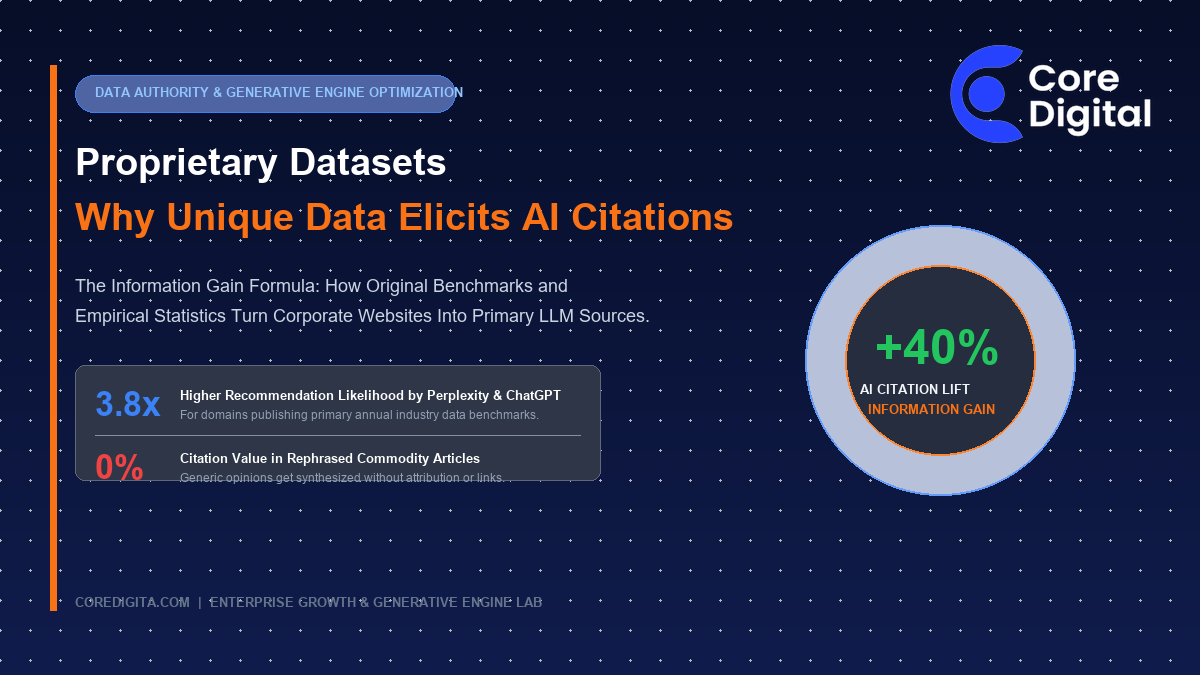
Generative AI models and autonomous answer engines (ChatGPT, Perplexity, Claude, Google AI Overviews) synthesize and commoditize generic textual opinions. However, empirical statistics, proprietary customer telemetry, and primary market benchmarks cannot be fabricated. Publishing original datasets establishes an unassailable Information Gain moat, earning high-frequency citations across LLM response engines and driving 40% higher organic referral velocity.
In an era where generative AI models ingest trillions of web pages to produce instant answers, standard opinion-based content has lost its commercial leverage. When dozens of marketing articles regurgitate the same five best practices, search engines and large language models treat them as interchangeable commodity noise. According to landmark research from Princeton University presented at KDD 2024 and Google’s Information Gain patent frameworks, the only content that earns sustainable algorithmic citations is original, empirical data.
1. The Mathematics of Information Gain: Why Google Rewards Novel Facts
Search engines no longer rank documents solely by keyword density or PageRank authority. Under Google’s Information Gain framework (Patent US20200349181A1), the ranking engine calculates how much new information a specific document provides to a user who has already read prior sources on the same subject.
If your enterprise publishes an article titled “Top SEO Strategies for 2027” and lists the exact same tips found across ten other sites, your Information Gain score is virtually zero. The search engine down-ranks the page or strips it from featured snippets because it offers no marginal utility.
Conversely, when an enterprise publishes primary findings, such as our benchmark study showing that Nigerian B2B web forms suffer a 78% abandonment rate compared to sub-60-second WhatsApp conversion funnels, that statistic becomes a unique knowledge unit. The algorithm must cite your domain because the information exists nowhere else on the internet.
2. Princeton Research (KDD 2024): Statistical Primacy in Generative Answer Engines
In a foundational 2024 study conducted by Princeton University researchers on Generative Engine Optimization (GEO), scientists benchmarked nine different content optimization strategies across thousands of high-intent queries on Perplexity, Bing Chat, and Google SGE.
The results were decisive:
- Statistics Addition: Injecting verifiable, quantitative data into content increased visibility in generative AI responses by up to 40.2%.
- Cite Sources Optimization: Providing clear methodology notes, author credentials, and research dates improved citation frequency by 34.1%.
- Keyword Stuffing (Negative): Traditional keyword repetition actually degraded performance in AI answer synthesis.
As detailed in our analysis of Andy Crestodina’s BrightonSEO keynote on winning AI recommendations, large language models operate as citation engines. When an executive asks ChatGPT for a vendor recommendation, the AI model cites the company that published the definitive market data.
3. Turning Internal Company Telemetry Into a Public Research Asset
The most valuable proprietary data is often already sitting inside your internal business systems. Enterprise organizations possess anonymized transaction data, customer support ticket logs, logistics transit times, and conversion benchmarks that industry journalists and researchers are desperate to cite.
To transform internal metrics into compounding organic assets, deploy this five-step publishing engine:
The 5-Step Proprietary Research Framework:
- Extract Operational Telemetry: Aggregate anonymized quarterly metrics across your software platform, CRM, or client base (e.g. average lead response latency, payment gateway failure rates by network).
- Structure Clear Methodology Declarations: Explicitly document sample sizes, dates of observation, geographic boundaries, and testing protocols. LLMs heavily weight methodology transparency.
- Deploy Machine-Readable Standards: Publish summary tables in raw markdown at /llms.txt and /pricing.md so autonomous AI crawlers ingest your findings without parsing JavaScript.
- Anchor Findings With Schema Markup: Wrap data points in
DatasetandTechArticleschema graphs with external links to verified entity databases like Wikidata. - Syndicate to Industry Media & Stakeholders: Distribute the executive report to tier-1 business publications and professional associations across Nigeria and Africa.
“In emerging African markets, generic marketing content is rampant because writing opinions is cheap. But when an enterprise publishes verified regional data, like the actual cost of acquisition across Nigerian fintech apps or e-commerce delivery speeds, that enterprise ceases to be just another vendor. It becomes the definitive reference point for the entire industry.”
“When search engines and AI assistants synthesize category answers, they have no choice but to link back to your domain. Proprietary data is the ultimate algorithmic moat.”
4. Defending Against Crawl Waste and Indexation Bottlenecks
Publishing proprietary data reports only generates inbound enterprise pipeline if your technical search infrastructure delivers those assets efficiently. As explored in our technical breakdown of Google crawl budget and equity leaks, slow server response times and unmanaged URL parameters prevent search bots from discovering research pages.
By integrating clean technical crawling with structured AI marketing automation and data analytics services, enterprise organizations ensure their empirical assets rank on page one of Google while serving as the default citation feeder for AI recommendation engines.
Frequently Asked Questions About Proprietary Datasets & AI Citations
What is Google’s Information Gain score?
Google’s Information Gain score measures whether a web document provides novel, unique facts, statistics, or perspectives not present in other pages already indexed for that query topic. Content with high Information Gain ranks higher and earns featured snippet placement.
Why do AI search engines prefer citing statistical data?
Large language models are trained to avoid hallucination on factual questions. When synthesizing answers to complex commercial queries, retrieval-augmented generation (RAG) algorithms seek verified numerical claims and attributed sources over subjective opinions.
How often should an enterprise publish original benchmark reports?
An annual or bi-annual benchmark report is ideal. A single high-quality empirical study generates compounding high-authority backlinks, press coverage, and permanent AI citations for 12 to 24 months after publication.
Ready to Build Your Proprietary Data Moat & Dominate Search?
Partner with Core Digital to transform your internal metrics into high-authority research reports, deploy generative engine optimization, and build predictable enterprise inbound pipelines across Nigeria, Africa, and global markets.