

Macro Marketing Playbook
The Macroeconomic Squeeze: When Rented Customer Acquisition Destroys EBITDA
In high-inflation emerging markets across Nigeria, Ghana, and Kenya, nominal revenue growth often hides collapsing profit margins. Global ad networks (Meta, Google, LinkedIn) price auctions in US dollars, while customer revenues are collected in depreciating local currencies. Standard 3:1 LTV:CAC benchmarks fail because inflation erodes the real present value of future cash flows. Surviving and scaling requires transitioning variable ad spend into compounding organic search assets, sub-60-day payback cycles, and automated retention workflows.
In boardrooms across Lagos, Nairobi, and Johannesburg, executive leadership teams are confronting an uncomfortable truth: top-line revenue growth can easily disguise severe structural decay in unit economics.
When headline inflation exceeds 25% and local currencies experience sharp foreign exchange depreciation, traditional Silicon Valley metrics like the 3:1 Customer Lifetime Value to Customer Acquisition Cost (LTV:CAC) ratio fail to protect corporate cash reserves. If customer acquisition costs are tied to dollar-denominated digital ad auctions while customer lifetime value is recovered in devaluing local currencies over twelve months, the business burns real capital with every new account it signs.
“During hyperinflation, customer acquisition is not an operational expense. It is a capital investment. If you rent your pipeline from ad auctions, your landlord raises the rent every single morning.”
What Is an Inflation-Adjusted LTV:CAC Ratio? (Direct Answer)
An inflation-adjusted LTV:CAC ratio measures the true purchasing power of customer lifetime gross profits against upfront customer acquisition costs. In high-inflation economies, the formula discounts future subscription or repeat payments by both the corporate cost of capital and the prevailing inflation rate. To maintain business solvency and profitability in emerging markets, companies must target an LTV:CAC ratio of 4.5:1 or higher, compress cash payback periods to under 60 days, and shift acquisition away from paid ads toward compounding organic search assets.
1. The Currency Mismatch Trap: Why Traditional Unit Economics Collapse
To understand why venture-backed and bootstrapped companies struggle in emerging markets, consider the mechanics of a typical digital customer acquisition funnel.
When a company runs performance ad campaigns on Google Ads, Meta, or LinkedIn, ad bids are fundamentally indexed to global US dollar clearing prices. If the Nigerian Naira depreciates from ₦460/$ to ₦1,600/$, or the Ghanaian Cedi slides by 30%, the local cost per click (CPC) and cost per acquisition (CPA) spike automatically.
The Asymmetric Squeeze on Local Balance Sheets:
- Dollarized Upfront Costs: Ad networks demand immediate settlement in foreign exchange or at volatile parallel market exchange rates.
- Lagging Local Pricing Power: B2B enterprise clients and consumers resist price hikes during inflationary periods. Annual contracts lock in revenues that lose real purchasing power monthly.
- Stretched Payback Cycles: A customer acquisition cost that previously took four months to recoup now takes 12 to 14 months of local billings to break even.
- Customer Churn from Cost Cutting: As business clients trim software budgets to conserve liquidity, customer lifespan shrinks exactly when extended retention is needed to recover costs.
This dynamic creates a negative compounding loop. The more paid ads a company buys to hit nominal revenue targets, the faster it drains operational cash flow.
2. The Harvard Mathematical Model: Adjusting LTV for Inflation and Discount Rates
In their seminal research for the Journal of Marketing Research and Harvard Business School, Sunil Gupta and Donald R. Lehmann demonstrated that Customer Lifetime Value is a discounted cash flow calculation. Ignoring inflation produces wildly optimistic valuations that lead straight to insolvency.
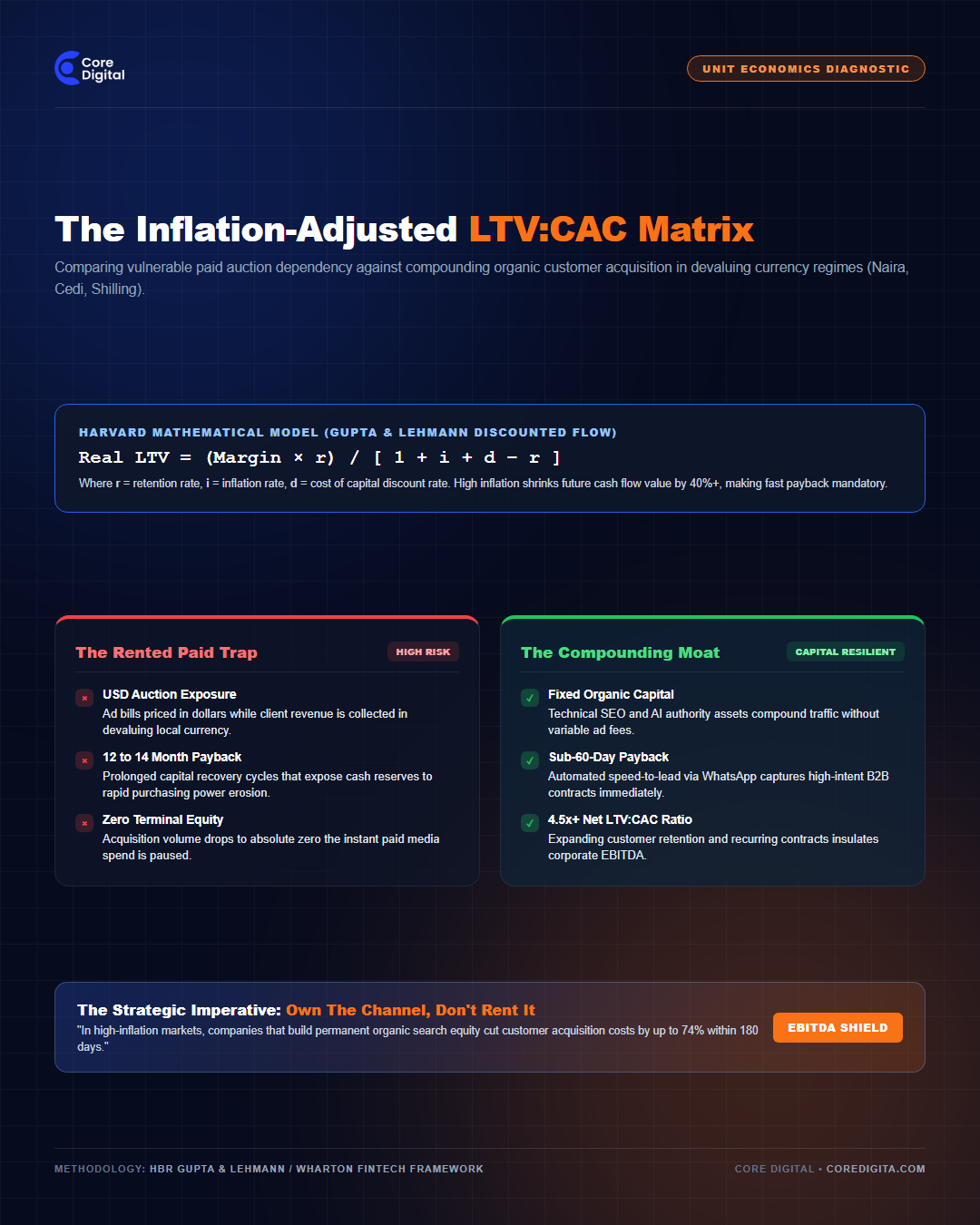
The Inflation-Adjusted LTV Formula
• Gross Margin: Net cash contribution per customer account per period.
• r: Customer retention rate per period.
• i: Macroeconomic inflation rate.
• d: Corporate cost of capital discount rate.
In a stable economic environment with 2% inflation (i = 0.02) and a 10% discount rate (d = 0.10), an 80% annual retention rate yields an effective denominator of (1 + 0.02 + 0.10 – 0.80) = 0.32.
Now recalculate that same business in Nigeria or Ghana, where headline inflation sits at 28% (i = 0.28) and prime corporate lending rates reach 30% (d = 0.30). The denominator blows out to (1 + 0.28 + 0.30 – 0.80) = 0.78.
The mathematical reality is stark: high inflation cuts the real present value of your customer base by more than 58%, even if customer churn remains completely unchanged. If your business model relies on a long, slow payback period to recover expensive ad spend, you are running at an economic loss.
3. The 4-Pillar Resilient Inbound Growth Architecture
How do market leaders break free from this macroeconomic trap? They shift their corporate acquisition model from rented variable expenses to owned compounding capital.
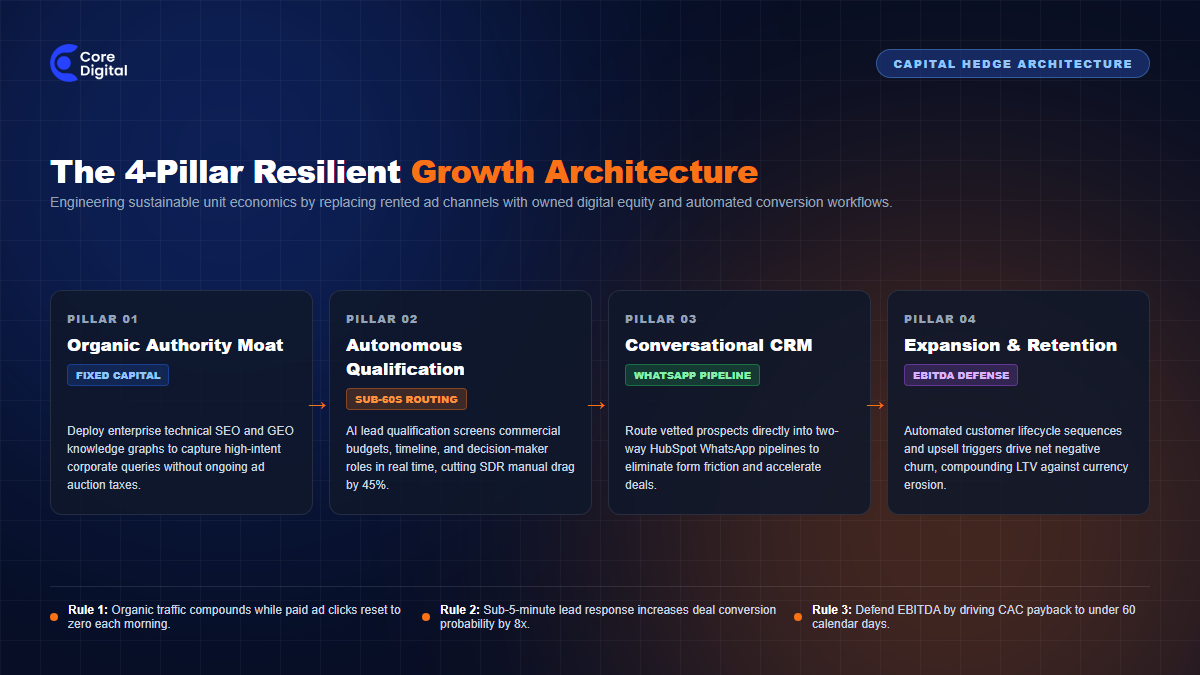
At Core Digital, we architect enterprise acquisition engines around four foundational pillars designed specifically to withstand inflationary shocks:
Pillar 1: The Organic Search Equity Moat (Fixed Capital)
Unlike paid search ads where every single visitor costs money, enterprise technical SEO and Generative Engine Optimization (GEO) represent fixed capital assets. Once your site ranks for high-intent unbranded keywords, that traffic flows 24/7 with zero marginal media cost. As ad prices rise in dollars, your marginal acquisition cost drops toward zero.
Pillar 2: Autonomous AI Lead Qualification (Speed-to-Lead)
Research demonstrates that responding to inbound B2B inquiries within five minutes multiplies conversion rates by 8x. By deploying autonomous AI agents to qualify budget, decision-making authority, and operational timelines instantly, companies eliminate SDR pipeline lag and prevent high-value enterprise leads from abandoning to competitors.
Pillar 3: Conversational WhatsApp CRM Integration (Closing Velocity)
In African commerce, enterprise deals stall in neglected email inboxes. Integrating the WhatsApp Business API directly with HubSpot or Salesforce creates instant two-way sales engagement. Compressing the sales cycle from 90 days down to 21 days directly accelerates cash collection, reducing exposure to currency depreciation.
Pillar 4: Expansion Revenue & Negative Net Churn (LTV Compounding)
Acquiring a new customer costs 5x to 7x more than expanding an existing relationship. By automating post-onboarding value milestones, automated usage reporting, and contract expansion triggers, high-performing businesses achieve Net Revenue Retention (NRR) above 115%. Expansion revenue acts as an automatic corporate inflation hedge.
4. Rented Paid Ad Model vs. Owned Inbound Capital Model
Compare the operational realities between companies relying on ad auctions versus those investing in owned digital infrastructure:
| Performance Metric | Rented Paid Ad Model | Owned Inbound Capital Model |
|---|---|---|
| Cost Volatility | High: Tied to dollar auctions and auction bid surges | Zero: Fixed investment creates permanent organic rankings |
| Payback Period | 10 to 14 months (highly vulnerable to currency slide) | Under 60 days via rapid qualification & WhatsApp routing |
| Average LTV:CAC Ratio | 1.8:1 to 2.4:1 (barely covering overhead) | 4.5:1 to 6.2:1 (delivering resilient net free cash flow) |
| Terminal Value & Equity | Zero: Pipeline drops to zero immediately if ad budget stops | High: Compounding organic search equity and domain authority |
| Resilience to Devaluation | Extremely fragile; margins collapse on FX depreciation | Robust; customer acquisition operates independently of FX |
5. Frequently Asked Questions (FAQ)
What is a healthy LTV to CAC ratio for B2B companies in emerging markets?
How does currency devaluation specifically impact digital customer acquisition?
Why is organic search considered a capital asset rather than an operating expense?
How can B2B enterprises compress their CAC payback time to under 60 days?